· four exchange APIs · rebuilt daily
How funding rates set the cost of carry perpetual futures traders pay

The finding
The funding spread on ARB perpetual contracts reaches 0.0300% per eight hours across exchanges, creating a 32.85% annualized difference in holding costs.
A long position incurs funding fees whenever the perpetual price trades at a premium to the spot index.
Exchange venue selection changes holding cost more than trading fee tier discounts over extended holding periods.
Selecting the wrong exchange for a long position adds up to 0.0900% per day in unhedged position drag.
The cost of carry perpetual futures traders face is driven almost entirely by funding rate payments rather than upfront transaction fees. Unlike traditional futures with fixed expiry dates, perps rely on periodic cash transfers between longs and shorts to tether contract prices to spot indices.
How Funding Acts as a Carrying Cost
When market sentiment is bullish, long positions pay short positions every eight hours. When sentiment turns bearish, short positions pay longs. This mechanism converts position duration into an ongoing interest liability or yield.
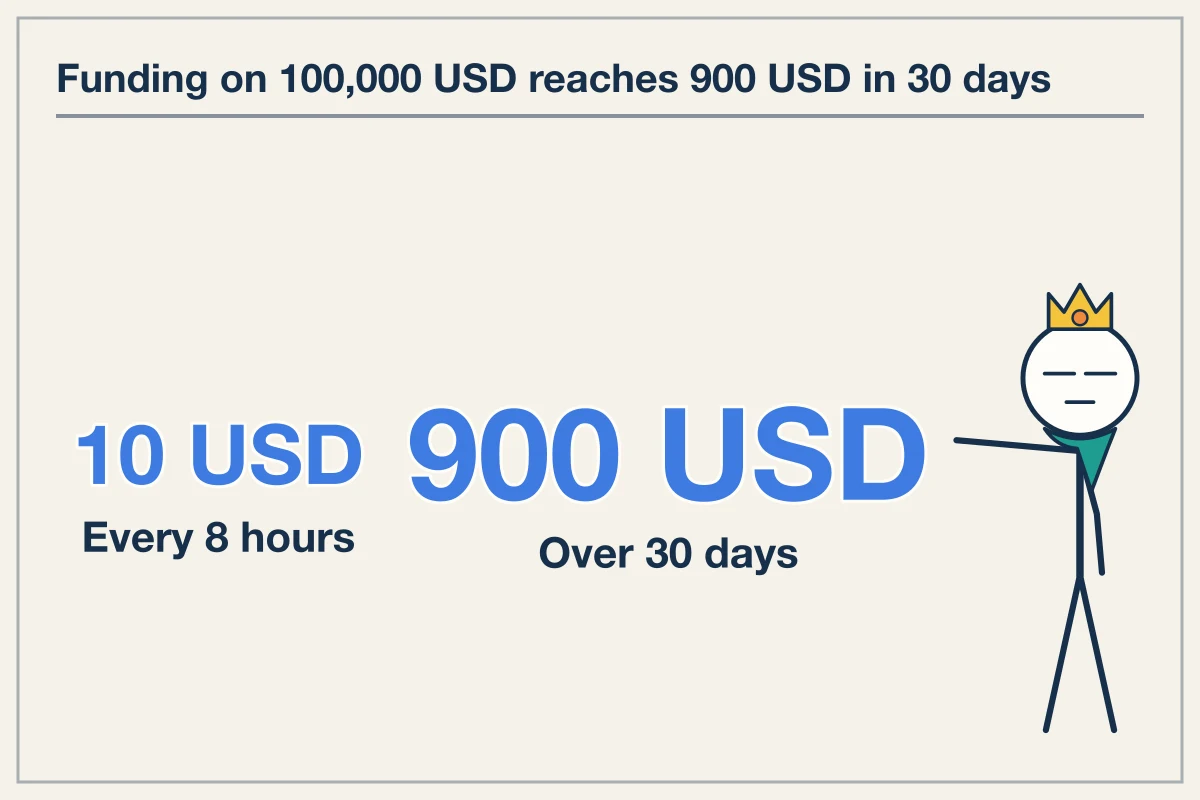
Trading fees are paid twice: at entry and at exit. Funding payments recur every eight hours, executing three times daily. On a 100,000 USD position, an 8-hour funding rate of +0.0100% deducts 10 USD from your margin balance three times a day. Over 30 days, that equals 90 payments totaling 900 USD, or 0.90% of the nominal position size.
Worth knowing
Negative funding rates turn carrying costs into positive yield for long positions, paying traders to hold directional risk.
Live Venue Spreads Across Major Contracts
Funding rates are not uniform across exchanges. Each exchange maintains its own order book, spot index weighting, and interest rate component. This structural independence creates wide spreads between venues for the exact same underlying asset.
| Asset | Highest Rate (8h) | Lowest Rate (8h) | 8h Spread | Lowest Cost Venue for Longs | 24h Volume |
|---|---|---|---|---|---|
| ARB | +0.0100% (Bitget) | -0.0200% (Bybit) | 0.0300% | Bybit | 367,036,084 USD |
| ZEC | +0.0100% (Bybit) | -0.0145% (Bitget) | 0.0245% | Bitget | 787,439,251 USD |
| DOGE | +0.0100% (Bitget) | -0.0009% (OKX) | 0.0109% | OKX | 476,375,734 USD |
| BTC | +0.0062% (Bitget) | -0.0018% (Bybit) | 0.0080% | Bybit | 2,129,244,587 USD |
| ETH | +0.0098% (MEXC) | +0.0050% (Bybit) | 0.0048% | Bybit | 3,100,267,567 USD |
| SOL | +0.0100% (Bitget) | +0.0066% (MEXC) | 0.0034% | MEXC | 740,984,350 USD |
The widest spread sits in ARB at 0.0300% per interval. Holding a long ARB position on Bitget costs 0.0100% every eight hours. Holding that same long on Bybit pays you 0.0200% every eight hours.
Comparing the cost of carry perpetual futures across venues
To evaluate total position drag, compare upfront execution fees against cumulative funding payments. Execution fees consist of maker and taker rates applied to nominal trade value.
| Exchange | Spot Maker | Spot Taker | Futures Maker | Futures Taker |
|---|---|---|---|---|
| Bitget | 0.100% | 0.100% | 0.020% | 0.030% |
| Bybit | 0.100% | 0.100% | 0.020% | 0.055% |
| MEXC | 0.000% | 0.050% | 0.000% | 0.020% |
| OKX | 0.080% | 0.100% | 0.020% | 0.050% |
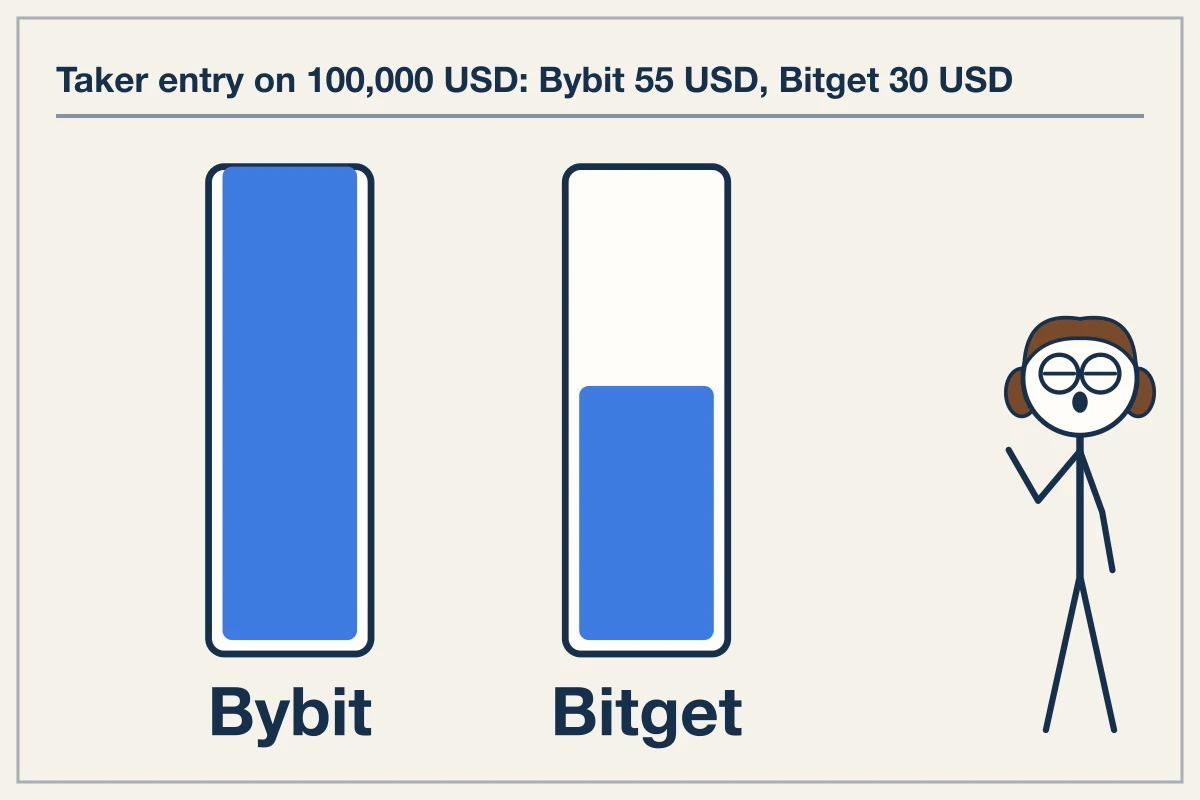
On Bybit, entering a 100,000 USD futures trade as a taker costs 55 USD (0.055%). On Bitget, taking the same trade costs 30 USD (0.030%). The entry fee difference is 25 USD.
However, if you hold a long ETH position for 30 days, Bybit charges +0.0050% per 8 hours while MEXC charges +0.0098%. Over 90 intervals, Bybit funding costs 450 USD while MEXC costs 882 USD. The 432 USD funding gap completely absorbs the initial fee variance within four days of holding.
Where this goes wrong
High leverage accelerates margin depletion from positive funding, pulling liquidation prices closer without price movement in the underlying asset.
Worked Arithmetic on a 100k USD Position
Consider a trader opening a 100,000 USD nominal long position in ZEC using 10x leverage. The collateral posted is 10,000 USD.
On Bybit, the ZEC funding rate is +0.0100% per 8 hours. Each settlement deducts 10 USD from account margin. Over 30 days (90 settlements), funding deductions total 900 USD. This represents a 9.0% loss on posted collateral, holding market price entirely static.
On Bitget, the ZEC funding rate is -0.0145% per 8 hours. Each settlement credits 14.50 USD to account margin. Over 30 days, the position earns 1,305 USD in funding yield. This represents a 13.05% positive return on posted collateral from carrying cost alone.
The total variance between venues over 30 days on ZEC is 2,205 USD on a 10,000 USD margin deposit.
What to do instead
Calculate projected funding drag using 30-day average rates before selecting a venue for swing positions.
What is the cost of carry in perpetual futures trading?
The cost of carry in perpetual futures is the cumulative net cost of holding a position over time, dominated by recurring funding rate payments every eight hours. It also incorporates initial and exit execution fees charged by the exchange. Depending on market premium and direction, this cost can be positive or negative.
How often do perpetual futures funding payments settle?
Perpetual futures funding payments settle every eight hours on most major exchanges, resulting in three settlement events per calendar day. Some exchanges alter interval timing during extreme volatility, but standard schedules calculate rate accruals at 00:00, 08:00, and 16:00 UTC.
What happens if you cannot pay perpetual futures funding fees?
Funding fees are automatically deducted directly from your available margin balance at each settlement interval. If continuous funding deductions deplete your margin balance below the required maintenance margin level, the exchange automatically liquidates your position.
Which exchange has the lowest funding cost for long ETH perpetuals?
Bybit currently offers the lowest holding cost for long ETH perpetual positions among major venues, charging +0.0050% per eight-hour interval. MEXC charges the highest rate at +0.0098% per interval, creating a spread of 0.0048% every eight hours.