· four exchange APIs · rebuilt daily
Why Dubai became a crypto hub and what VARA requires from desks

The finding
Dubai built its crypto hub around VARA and free zone frameworks, driving over $19.7 billion in daily perpetual futures volume across four major venues.
VARA regulates virtual asset service providers onshore in Dubai, while financial zones like DIFC maintain separate common law courts.
Exchanges structure offshore and local entities differently to offer derivatives without triggering retail leverage bans.
The regulatory split between VARA and financial free zones
Dubai structured its market using two distinct regulatory jurisdictions. The Virtual Assets Regulatory Authority (VARA) governs onshore Dubai and its non-financial free zones. VARA operates as a standalone virtual asset regulator, establishing rules for exchange operations, custody, and broker-dealer services.
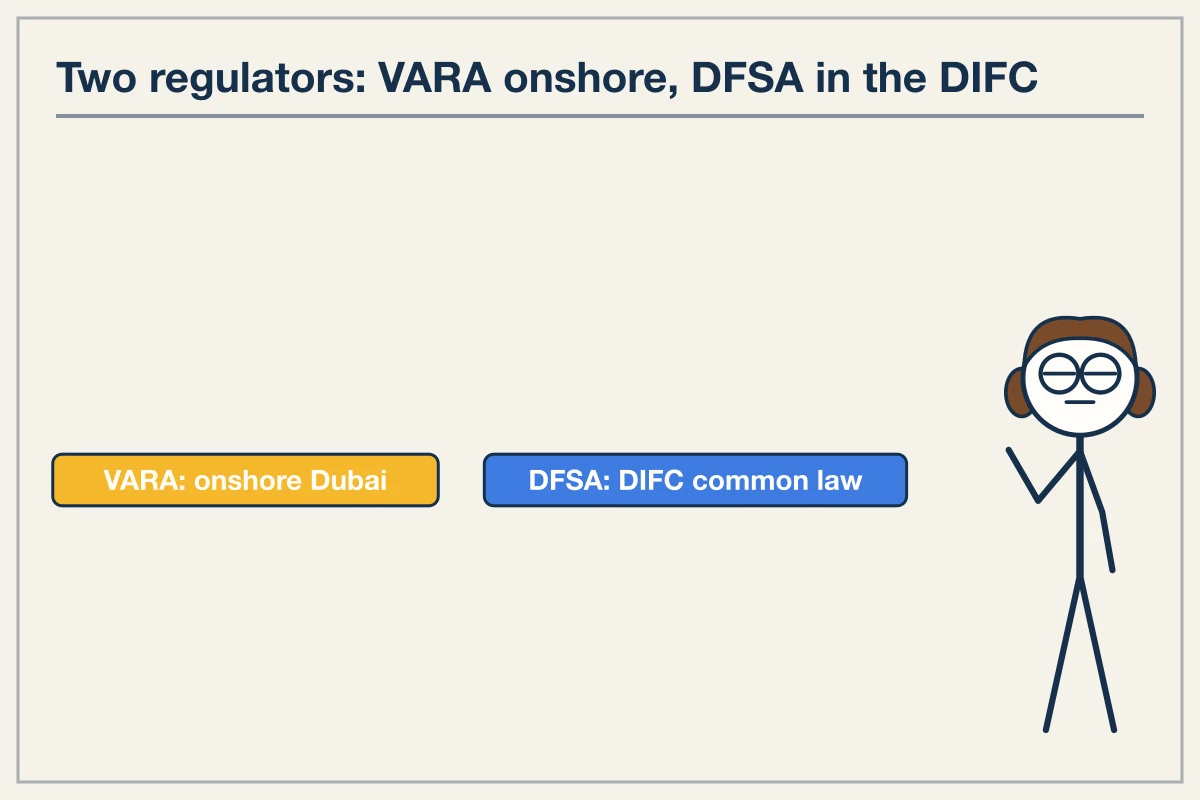
In contrast, financial free zones like the Dubai International Financial Centre (DIFC) operate under independent civil and commercial laws based on English common law. The Dubai Financial Services Authority (DFSA) regulates financial activities within the DIFC, treating crypto tokens under a separate regulatory framework.
This split means an entity operating in the DIFC cannot automatically offer retail crypto trading onshore in Dubai without meeting VARA rules. Global perpetual venues frequently establish local corporate entities in Dubai to secure operational presence, while routing high-leverage derivative order flow through offshore entities incorporated in jurisdictions outside VARA jurisdiction.
Worth knowing
VARA rules prohibit market participants from offering privacy coins like ZEC within onshore Dubai, creating distinct product availability across local and offshore exchange entities.
Dubai crypto hub why venue licensing dictates trading access
The primary driver behind Dubai as a crypto hub is regulatory clarity paired with tax structure. VARA introduced a phased licensing model comprising Rulebooks for Exchange Services, Broker-Dealer Services, Lending and Borrowing, and Management and Investment Services.
To secure an operational license under VARA, venues must meet mandatory compliance standards:
- Minimum capital requirements tied to projected operational expenditure and trade volume.
- Segregation of client funds in dedicated operational bank accounts.
- Market conduct monitoring to detect wash trading and market manipulation.
- strict customer due diligence and travel rule compliance for transfers.
For derivative traders, these requirements determine whether a venue offers direct access to local bank rails or restricts services to crypto-to-crypto perpetual contracts. Venues operating strictly under offshore permissions maintain flexible leverage tiers, whereas local onshore entities face stricter suitability checks and reduced leverage ceilings for retail clients.
Where this goes wrong
Trading on an offshore arm of a Dubai-based entity means your collateral sits outside VARA oversight, leaving fund recovery subject to the offshore entity's jurisdiction during insolvency.
Perpetual funding and execution costs across major venues
Exchanges establishing regional operations in Dubai continue to compete globally on fee schedules and funding rate efficiency. Across major markets—ETH, BTC, SNDK, ZEC, SOL, and XAU—the combined 24-hour perpetual volume reaches $19,748,414,521.
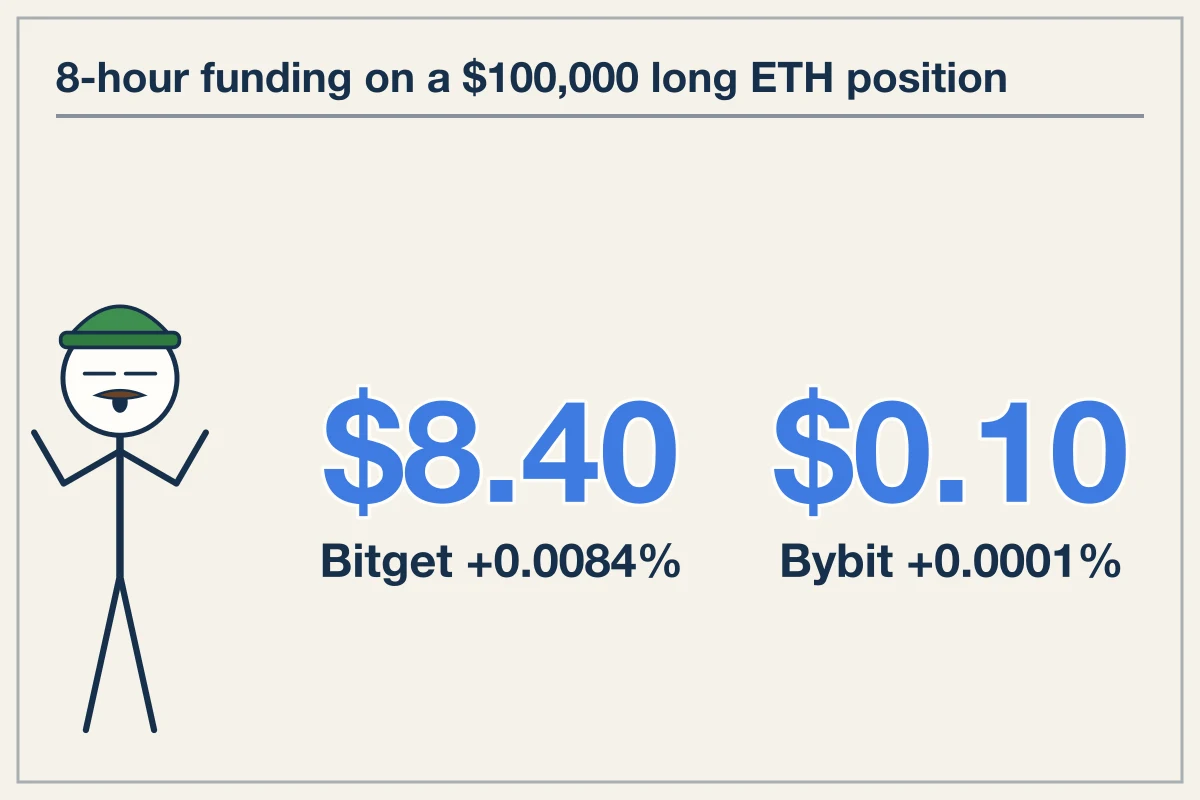
Holding a long or short position across these venues incurs different carrying costs. On ETH perpetuals, representing $7,616,498,739 in 24-hour volume, Bybit charges a funding rate of +0.0001% per 8 hours, while Bitget charges +0.0084%. Holding a $100,000 long ETH position on Bitget costs $8.40 per 8-hour interval in funding, compared to $0.10 on Bybit.
| Venue | ETH 8h Funding | BTC 8h Funding | SOL 8h Funding | Futures Maker Fee | Futures Taker Fee |
|---|---|---|---|---|---|
| Bybit | +0.0001% | -0.0014% | -0.0100% | 0.0002 | 0.00055 |
| Bitget | +0.0084% | -0.0002% | -0.0018% | 0.0002 | 0.0003 |
| OKX | +0.0060% | +0.0003% | -0.0083% | 0.0002 | 0.0005 |
| MEXC | +0.0017% | +0.0005% | +0.0006% | 0.0000 | 0.0002 |
Funding rate spreads widen significantly on altcoins. On ZEC, which generates $1,389,216,495 in 24-hour volume, Bitget prints a funding rate of -0.0231% per 8 hours while Bybit prints +0.0100%. The spread between the two venues is 0.0331% per 8 hours. Short positions on Bitget pay 0.0231% every 8 hours, while shorts on Bybit receive 0.0100%.
What to do instead
Compare the 8-hour funding rate against the taker fee before opening a swing position. A 0.0331% funding spread per 8 hours equals 0.0993% daily, exceeding typical futures taker fees within 24 hours.
Structural impact on account holding and leverage
The venue you select dictates both fee drag and legal recourse. Taker fees range from 0.0002 on MEXC to 0.00055 on Bybit. On a $100,000 position entry and exit, a taker fee of 0.00055 incurs $110 in total execution friction, whereas a taker fee of 0.0002 incurs $40.
When funding rates turn negative, such as SOL on Bybit at -0.0100% per 8 hours, short position holders pay long position holders $10.00 per 8 hours on a $100,000 trade. Conversely, MEXC prints +0.0006% for SOL, requiring longs to pay shorts $0.60 per 8 hours.
Exchanges operating out of Dubai adjust these parameters dynamically based on global order book depth rather than local jurisdictional lines. Consequently, institutional desks evaluate venues based on net holding cost—combining the taker fee with multi-day funding rate drift—rather than corporate office location alone.
Why did Dubai set up VARA as a dedicated crypto regulator?
Dubai established VARA under Law No. 4 of 2022 to create a specialized legal framework for digital assets distinct from traditional financial services. This provides direct oversight for exchanges, custody providers, and brokers operating onshore in Dubai.
How do Dubai free zones differ from VARA jurisdiction?
Financial free zones like the DIFC operate under separate financial authorities like the DFSA and use English common law courts. VARA regulates onshore Dubai and non-financial free zones, meaning licenses issued in one jurisdiction do not automatically grant operational rights in the other.
Does trading on a VARA-regulated exchange limit perpetual leverage?
VARA rules impose strict client categorization and market conduct rules onshore, which restrict retail leverage. To offer high-leverage perpetual contracts, global venues typically direct derivative trading through separate offshore legal entities.