· four exchange APIs · rebuilt daily
When you sent crypto to wrong network, key control dictates recovery
The finding
Recoverability is strictly determined by key derivation: self-custody EVM mistakes are 100% recoverable, while unsupported non-EVM routing to an exchange results in total loss.
EVM chains share identical public-private keypairs across networks.
Centralized exchanges control destination keys and dictate recovery eligibility.
Manual exchange extraction requires customized engineering, often carrying fixed recovery costs or strict minimum balance thresholds.
If you sent crypto to wrong network destinations, recovery is either a standard key import or impossible without venue intervention. The underlying mechanism depends on address derivation and private key custody.
Address derivation across compatible rails
Ethereum Virtual Machine (EVM) networks like Ethereum, Polygon, Arbitrum, Optimism, and BNB Chain use the same secp256k1 elliptic curve cryptography to generate addresses. Your public key on Ethereum is mathematically identical to your public key on Polygon or Arbitrum. When tokens are dispatched to an address on an unintended EVM chain, the assets exist on that network at the identical public address.
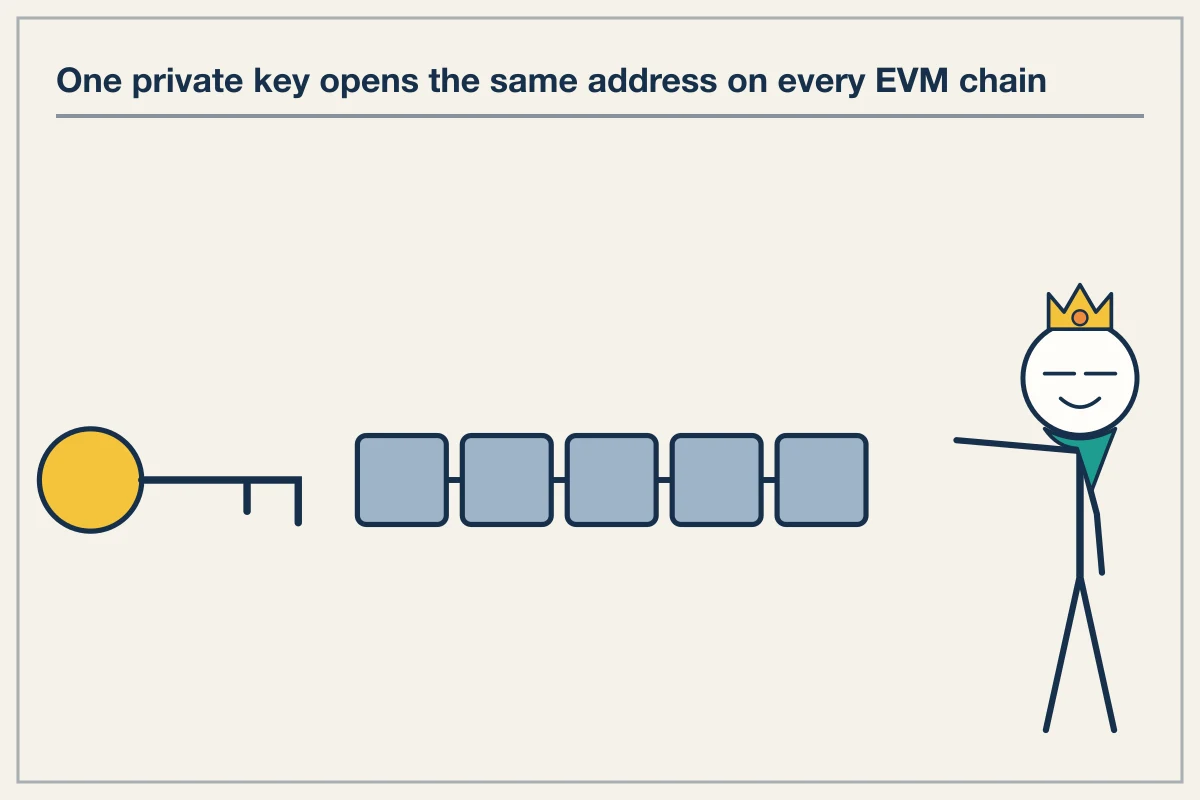
Accessing those assets does not require network intervention or custom chain reorganizations. It requires pointing a wallet interface that holds your private key to the destination Remote Procedure Call (RPC) endpoint.
Worth knowing
A private key controls the same public address on every EVM-compatible chain. Importing your recovery phrase into a multichain interface grants immediate access to assets sent on unintended EVM networks.
Steps to take after you sent crypto to wrong network addresses
The protocol for asset retrieval differs depending on whether the receiving address is a self-custody wallet or an exchange deposit account.
First, locate the transaction hash on the source network block explorer. Confirm that the transaction status is marked as successful and note the contract or wallet address that received the transfer.
Second, check if the receiving destination is a self-custody wallet where you hold the seed phrase or private key. If yes, add the target chain's RPC custom network settings into your wallet interface, such as MetaMask or Rabby. Select the newly added network, and the assets will display under your address balance.
Third, if the receiving destination is an exchange deposit address, check whether the exchange supports the network you used. If the exchange supports the token and network combination, the deposit usually credits automatically or via an automated self-service recovery tool. If the network is unmapped by the platform, you must open a customer support ticket with the transaction hash, deposit address, and exact token amount.
Where this goes wrong
Expecting support staff to manually extract private keys introduces operational risk. Never share your private keys, seed phrases, or remote session access with external services claiming to offer token recovery.
Exchange recovery procedures and baseline fee structures
When misrouted funds land on a centralized venue, manual intervention is required because internal database ledgers do not monitor unmapped smart contracts or unsupported RPC nodes. Processing a recovery requires engineers to isolate the individual private key in a secure offline environment, broadcast a custom transaction to return funds to an external wallet, and update internal balances.
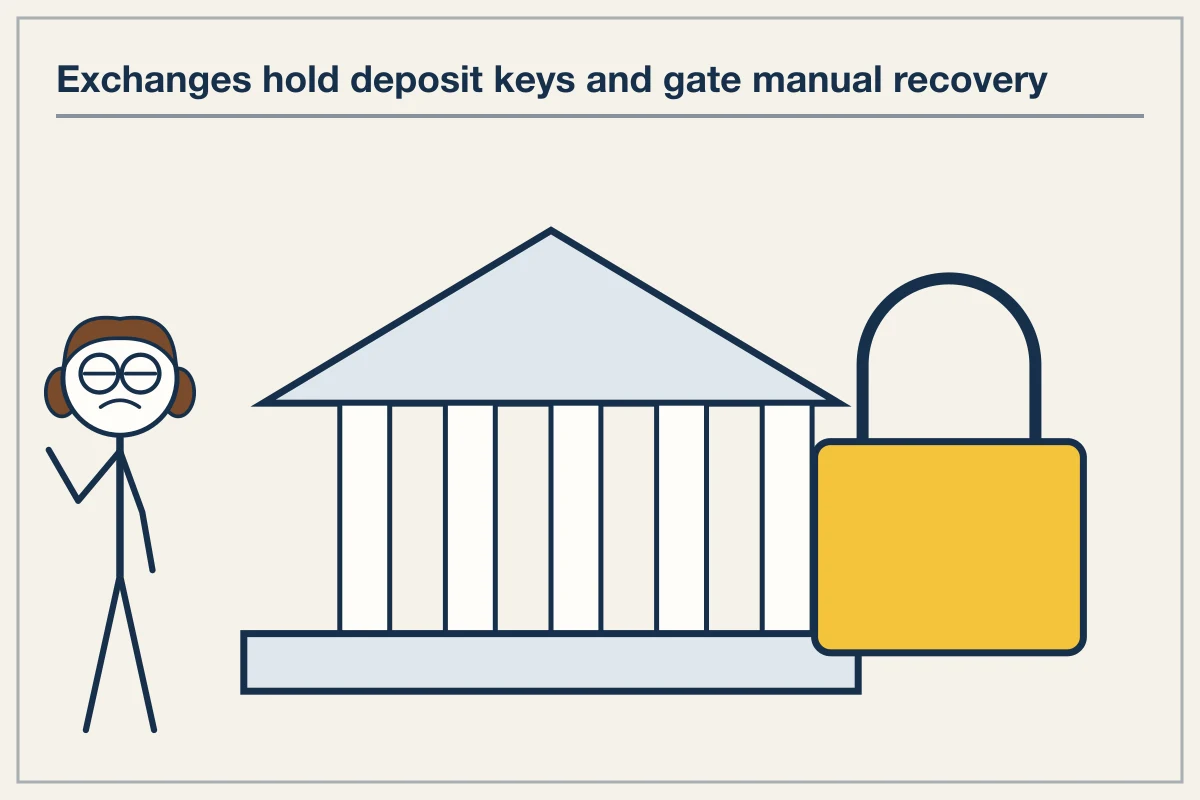
Due to operational security constraints, exchanges often set minimum token value thresholds for manual retrieval. Processing fees vary by platform, but standard trading fee baselines offer context for exchange operational structures:
| Venue | Spot Maker Fee | Spot Taker Fee | Futures Maker Fee | Futures Taker Fee |
|---|---|---|---|---|
| Bitget | 0.0010 | 0.0010 | 0.0002 | 0.0003 |
| Bybit | 0.0010 | 0.0010 | 0.0002 | 0.00055 |
| MEXC | 0.0000 | 0.0005 | 0.0000 | 0.0002 |
| OKX | 0.0008 | 0.0010 | 0.0002 | 0.0005 |
If the misrouted transaction value is lower than the operational cost of manual extraction, exchanges will decline the recovery request, leaving assets locked indefinitely on their deposit address.
What to do instead
Send a small test transaction before submitting full balances when transferring funds between exchanges or across non-native bridge routes.
Conditions where funds are permanently irrecoverable
There are two distinct scenarios where cross-network misrouting results in permanent capital loss without any possibility of retrieval.
The first occurs when tokens are sent across incompatible cryptographic architectures. For instance, broadcasting a native Solana transaction directly to a Bitcoin taproot public address fails at the protocol consensus layer or burns the payload if submitted via invalid wrapped bridge contracts. Because key derivation differs fundamentally across non-EVM chains, no matching private key exists on the destination ledger.
The second scenario occurs when funds are sent directly to an unmanaged smart contract address that lacks transfer or withdrawal functions. If tokens are routed to a bridge contract address or a token contract missing fallback execution logic, the assets are permanently locked in the contract bytecode. No entity holds a private key for a smart contract execution address, making technical extraction impossible.
What should I do first if I misroute a transfer to a self-custody wallet?
Add the custom RPC network settings of the target network to your wallet interface. Because EVM addresses share identical private keys across chains, your assets will appear automatically once connected to the correct chain identifier.
Can an exchange recover tokens sent over an unsupported non-EVM network?
No, exchanges cannot retrieve tokens sent across incompatible cryptographic architectures where key derivation fails. If the exchange does not maintain technical infrastructure or private key access for that network, the funds are permanently lost.
Why do centralized exchanges charge processing fees for manual deposit recovery?
Extracting funds from unmapped deposit addresses requires manual technical intervention and hot wallet key management outside standard automated deposit sweeps. Venues impose operational fees or balance minimums to cover engineering overhead and security risks.
Are tokens sent to an unmanaged smart contract address recoverable?
No, smart contract execution addresses do not possess private keys. If funds are sent directly to a token or bridge contract that lacks automated withdrawal logic, the tokens remain permanently locked in the state bytecode.