· four exchange APIs · rebuilt daily
SNDK Funding Spreads Reach 0.0344 Percent Per 8 Hours Across Venues
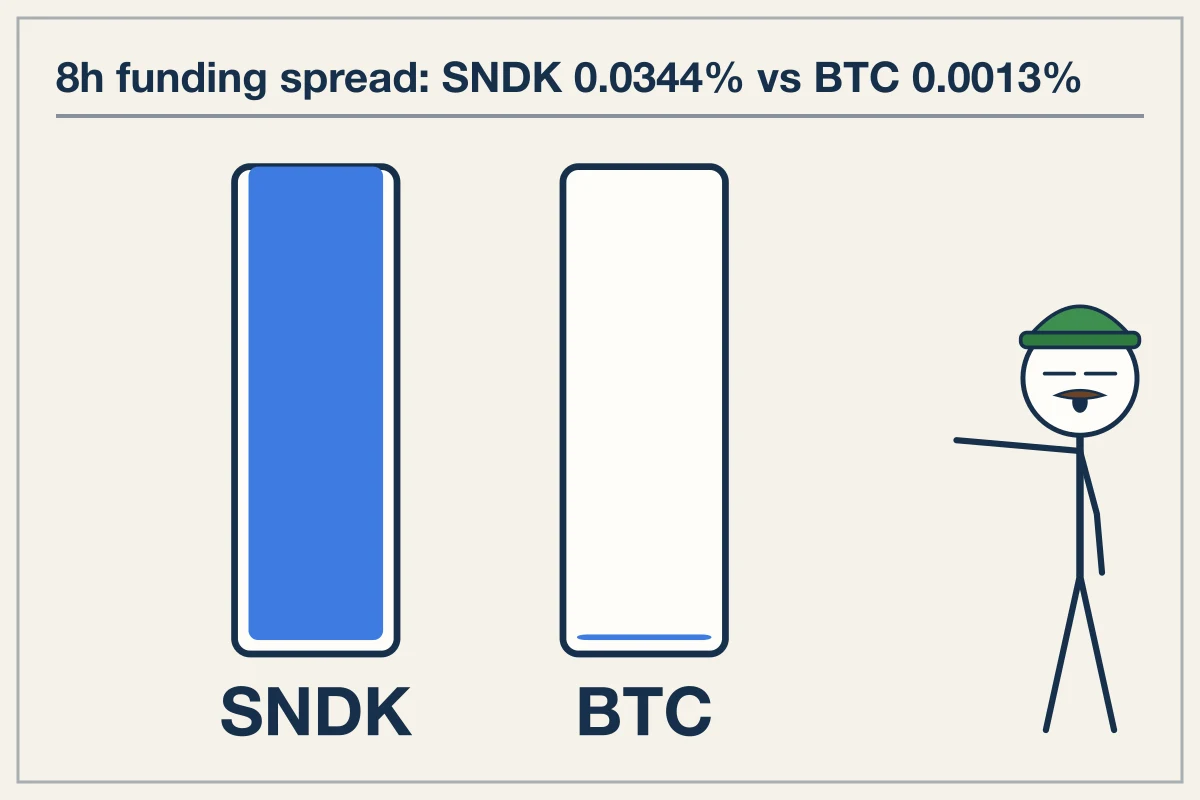
Funding rate spreads reach 0.0344 percentage points per 8 hours on SNDK, driving position carrying costs across crypto and synthetic asset venues.
Sovereign Capital Retention and Market Carrying Costs
Across six perpetual swap markets representing $20,358,465,469 in 24-hour volume, 8-hour funding rate spreads between exchanges reach up to 0.0344 percentage points.
The underlying mechanism of capital preservation across both sovereign tax havens and derivative venues relies on eliminating structural leakage. Why is Monaco so wealthy? Monaco retains sovereign wealth because its tax policy imposes zero direct personal income tax and zero capital gains tax on residents. Capital accumulates not through superior asset yield, but through the total elimination of recurring fiscal drag. Over the last decade, residency demographics shifted from passive high-net-worth heirs to active hedge fund managers, quantitative traders, and technology founders. These entities relocate capital to preserve principal against compounding tax erosion.
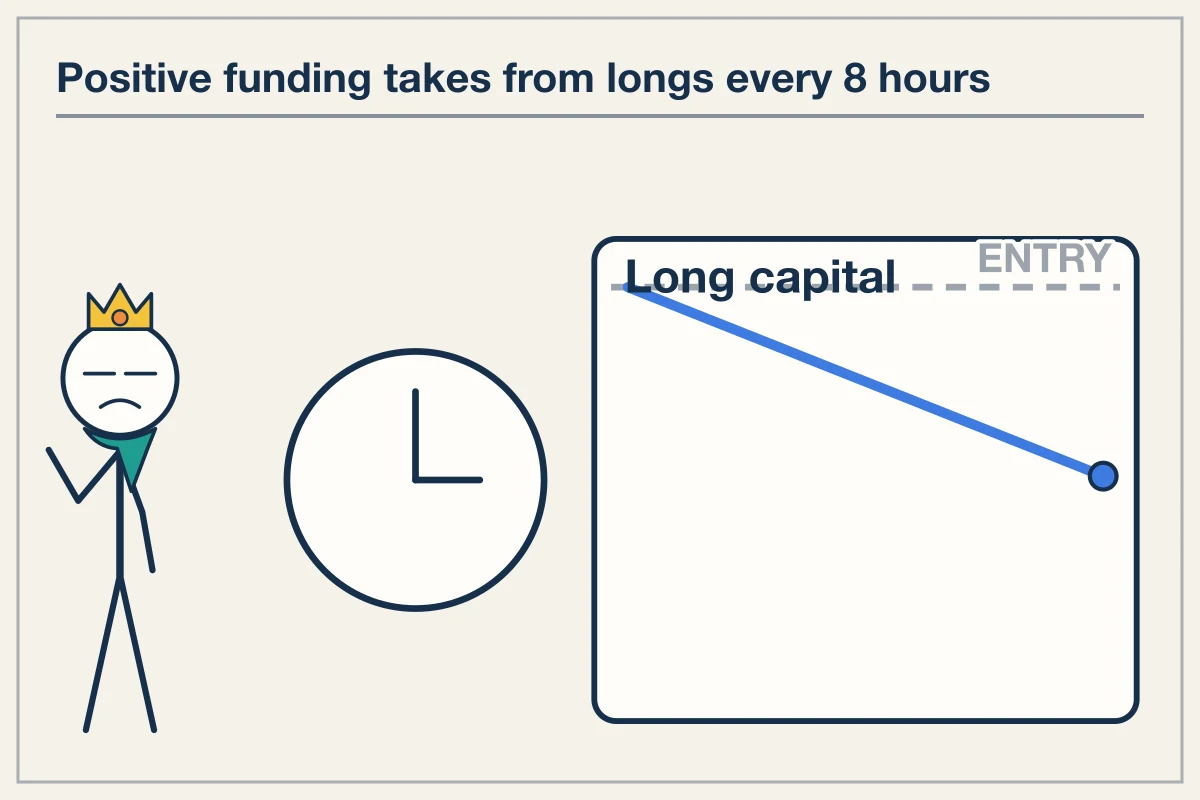
In perpetual futures markets, funding rates and fee schedules exert the exact same structural force on open positions. A position held across disparate exchanges experiences differential decay based on venue-specific imbalance mechanisms. When holding long positions, positive funding rates extract capital every 8 hours and transfer it to short holders. Conversely, negative funding rates pay long holders. Evaluating venue selection requires mapping these exact carrying costs against execution fee structures.
Cross-Venue Funding Rate Analysis
Funding rates are normalized to 8-hour settlement intervals. The table below outlines current funding rates across six assets and three execution venues, alongside total 24-hour market volumes.
| Asset | MEXC 8h Rate | OKX 8h Rate | Bitget 8h Rate | 8h Spread | Lowest Rate Venue (Longs) | 24h Volume ($) |
|---|---|---|---|---|---|---|
| ETH | +0.0022% | +0.0067% | +0.0100% | 0.0078% | MEXC | 7,887,612,734 |
| BTC | +0.0100% | +0.0100% | +0.0087% | 0.0013% | Bitget | 7,416,681,080 |
| SOL | -0.0004% | +0.0056% | -0.0027% | 0.0083% | Bitget | 2,112,038,638 |
| SNDK | N/A | +0.0344% | +0.0000% | 0.0344% | Bitget | 1,370,731,452 |
| TRUMP | N/A | -0.0033% | +0.0050% | 0.0083% | OKX | 997,304,702 |
| XAU | +0.0024% | +0.0000% | +0.0012% | 0.0024% | OKX | 574,096,863 |
The largest absolute funding divergence occurs in SNDK, where OKX charges long positions +0.0344% per 8 hours while Bitget maintains a +0.0000% rate. Over 24 hours (3 funding intervals), an OKX SNDK long position incurs a cumulative funding cost of +0.1032%, whereas the same position on Bitget incurs +0.0000%.
For SOL, Bitget offers a negative funding rate of -0.0027% per 8 hours, whereas OKX charges +0.0056%. Long positions on Bitget collect funding payments, while long positions on OKX pay funding charges.
Exchange Fee Schedule Friction
Execution fees represent an upfront capital deduction occurring at order entry and exit. Published default futures and spot fee schedules differ significantly across venues.
| Exchange | Spot Maker Fee | Spot Taker Fee | Futures Maker Fee | Futures Taker Fee |
|---|---|---|---|---|
| Bitget | 0.1000% (0.0010) | 0.1000% (0.0010) | 0.0200% (0.0002) | 0.0300% (0.0003) |
| Bybit | 0.1000% (0.0010) | 0.1000% (0.0010) | 0.0200% (0.0002) | 0.0550% (0.00055) |
| MEXC | 0.0000% (0.0000) | 0.0500% (0.0005) | 0.0000% (0.0000) | 0.0200% (0.0002) |
| OKX | 0.0800% (0.0008) | 0.1000% (0.0010) | 0.0200% (0.0002) | 0.0500% (0.0005) |
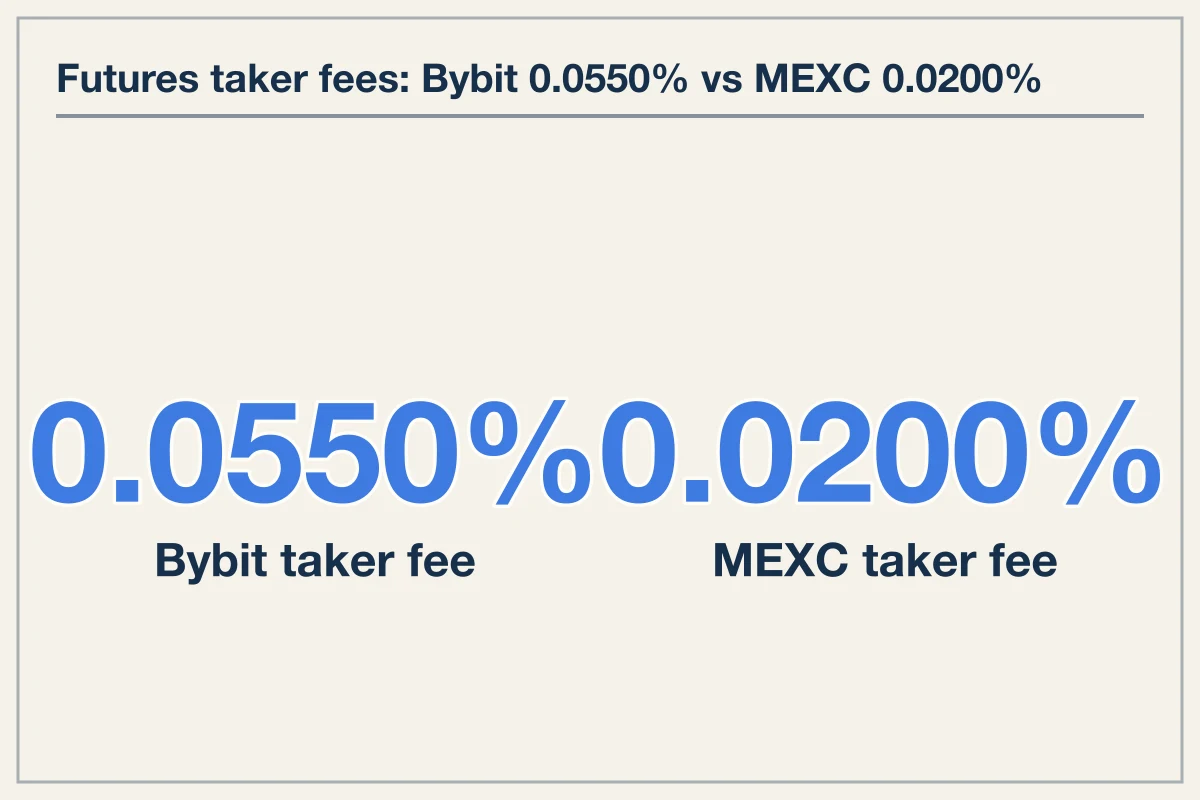
Futures taker fees range from 0.0200% on MEXC to 0.0550% on Bybit. Entry and exit taker orders on Bybit total 0.1100% in round-trip fee friction, compared to 0.0400% on MEXC. Futures maker fees range from 0.0000% on MEXC to 0.0200% on Bitget, Bybit, and OKX.
Carrying Cost Worked Example
For a position of nominal value $N$ held over $k$ settlement periods of 8 hours, total carrying cost equals:
Positional Friction = $(N \times \text{Taker Fee}_{\text{entry}}) + (N \times \text{Taker Fee}_{\text{exit}}) + \sum_{i=1}^{k} (N \times r_i)$
where $r_i$ represents the 8-hour funding rate for period $i$. Assume a benchmark position size $N = 100,000$ USD held over $k = 30$ consecutive funding intervals (240 hours).
Case 1: SNDK Long Position ($100,000 USD Notional)
On OKX, the 8-hour funding rate is +0.0344% ($0.000344$).
- Single 8h funding fee = $100,000 \times 0.000344 = 34.40$ USD
- 30-interval funding cost = $34.40 \times 30 = 1,032.00$ USD
- Round-trip taker fee ($0.0005 + 0.0005 = 0.0010$) = $100,000 \times 0.0010 = 100.00$ USD
- Total positional friction on OKX = $1,032.00 + 100.00 = 1,132.00$ USD
On Bitget, the 8-hour funding rate is +0.0000% ($0.000000$).
- Single 8h funding fee = $100,000 \times 0.000000 = 0.00$ USD
- 30-interval funding cost = $0.00$ USD
- Round-trip taker fee ($0.0003 + 0.0003 = 0.0006$) = $100,000 \times 0.0006 = 60.00$ USD
- Total positional friction on Bitget = $60.00$ USD
The differential friction between OKX and Bitget for holding a $100,000 USD SNDK long over 30 intervals equals $1,072.00$ USD ($1,132.00 — 60.00$).
Case 2: ETH Long Position ($100,000 USD Notional)
On Bitget, the 8-hour funding rate is +0.0100% ($0.000100$).
- 30-interval funding cost = $100,000 \times 0.000100 \times 30 = 300.00$ USD
- Round-trip taker fee ($0.0003 + 0.0003 = 0.0006$) = $60.00$ USD
- Total friction on Bitget = $360.00$ USD
On MEXC, the 8-hour funding rate is +0.0022% ($0.000022$).
- 30-interval funding cost = $100,000 \times 0.000022 \times 30 = 66.00$ USD
- Round-trip taker fee ($0.0002 + 0.0002 = 0.0004$) = $40.00$ USD
- Total friction on MEXC = $106.00$ USD
Holding the ETH position on Bitget incurs $254.00$ USD ($360.00 — 106.00$) in additional friction relative to MEXC over 30 intervals.
Practical Consequences of Position Friction
Cumulative funding fees and execution drag directly reduce account margin balance over time. When market volatility moves against a position, uncompensated funding drag accelerates collateral depletion.
If an account maintains insufficient excess margin, uncompensated funding deductions drive the position's margin ratio below the required maintenance threshold. This triggers mandatory liquidation by the exchange matching engine. In leveraged perpetual trading, liquidation failure rates increase when funding fees continuously drain available collateral during sideways or adverse price movements. Holding positions on venues with uncompetitive funding rates subjects collateral to accelerated decay and heightened liquidation risk.