· four exchange APIs · rebuilt daily
Market Orders Eat Thin Books When Liquidation Engine Triggers ADL
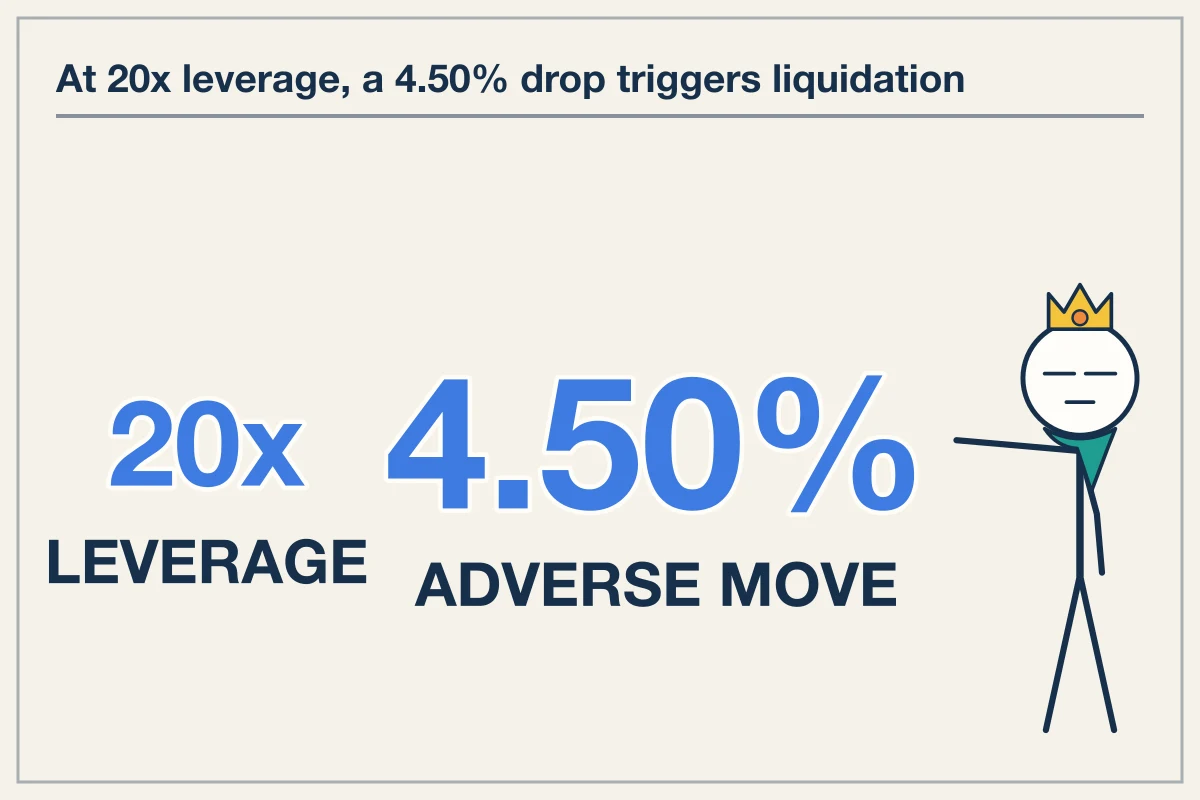
Forced market orders trigger liquidation cascades when mark price updates push maintenance margin breaches across clustered price levels.
At 20x leverage, a 4.50% adverse price move reduces margin balance below the 0.50% maintenance threshold, forcing the liquidation engine to take control of the position. Liquidation cascades occur when forced market orders clear visible order book depth, driving prices lower and triggering adjacent maintenance margin failures.
Mechanics of the Cascade Trigger
Exchanges compute margin requirements using a mark price rather than the last traded price. The mark price relies on an index price aggregated from external spot venues combined with a decaying funding basis moving average. This structure prevents localized order book manipulation from triggering liquidations.
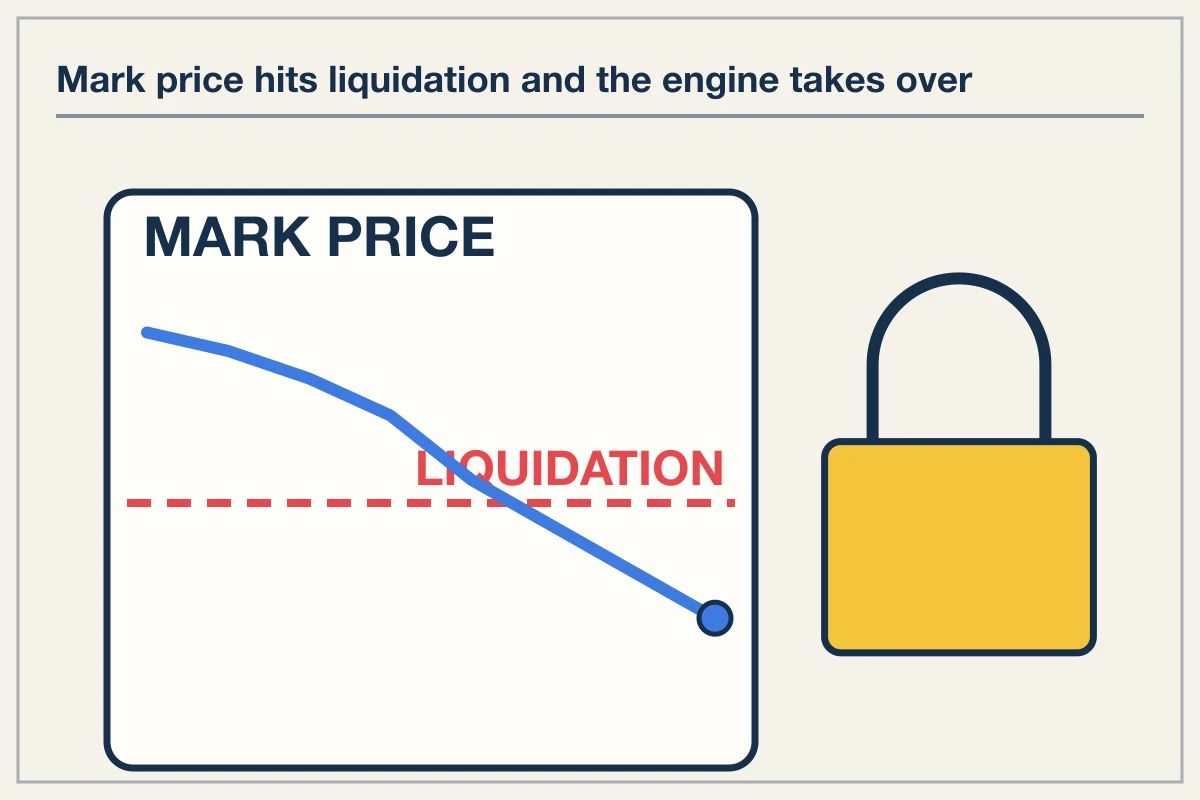
When mark price reaches the liquidation price, the trader loses control of the position. The venue engine cancels all open orders for that account and submits aggressive taker orders to close the exposure. If multiple positions cluster at nearby price levels, the market impact of the initial forced orders shifts the spot index and local order book depth, causing subsequent mark price updates to trigger adjacent liquidation orders in a rapid loop.
Forced Market Orders and Book Depth
When an engine liquidates a position, it executes taker market orders against the public order book. Taker fees are applied to these forced transactions. Fee structures differ across exchange venues, altering the total friction incurred during execution.
| Venue | Futures Maker Fee | Futures Taker Fee | Spot Maker Fee | Spot Taker Fee |
| Bitget | 0.020% | 0.030% | 0.100% | 0.100% |
| Bybit | 0.020% | 0.055% | 0.100% | 0.100% |
| MEXC | 0.000% | 0.020% | 0.000% | 0.050% |
| OKX | 0.020% | 0.050% | 0.080% | 0.100% |
At a 0.055% taker fee on Bybit, closing a forced $200,000 position costs $110 in fee friction alone before book slippage is calculated. On MEXC, the taker fee for the same nominal position is $40 at 0.020%.
Worked Example of Liquidation Slippage
Consider a long position opened with $10,000 initial margin at 20x leverage. Total nominal size is $200,000, representing 2,000 units at an entry price of $100.00. The maintenance margin requirement is 0.50%, or $1,000.
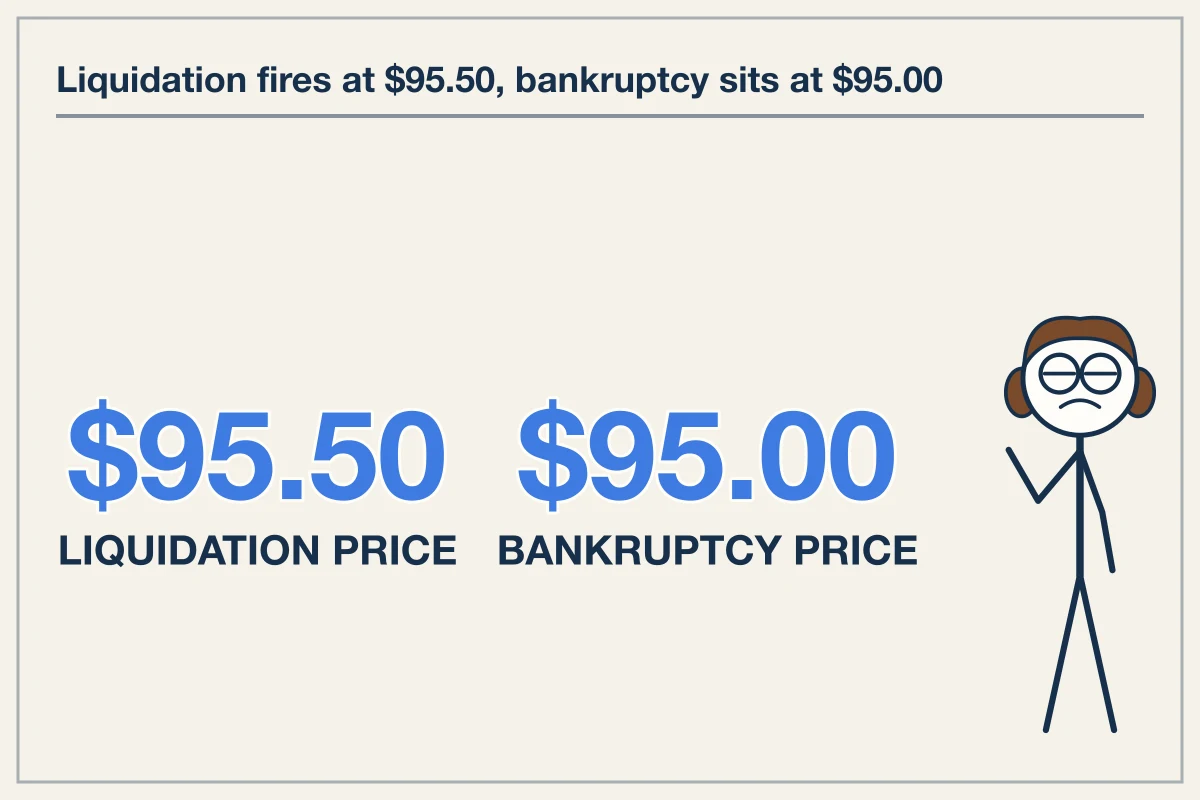
The liquidation price is reached when equity equals $1,000. This occurs at $95.50, representing a 4.50% drop from entry. At $95.50, the unrealized loss is $9,000, leaving exactly $1,000 in account margin.
The liquidation engine takes over at $95.50 and fires a taker market order to sell 2,000 units. The bankruptcy price—the point where margin reaches zero—is $95.00.
If bid depth is thin, execution slips past the bankruptcy price:
- The top bid levels absorb 500 units at an average price of $94.50.
- The next bid levels absorb 1,000 units at an average price of $93.00.
- The remaining 500 units fill at $91.50.
The weighted average execution price for the 2,000 units is $93.00. Total proceeds from closing the position are $186,000.
The total realized loss is $14,000 ($200,000 initial size minus $186,000 exit value). Because initial margin was $10,000, the account balance drops to -$4,000.
Insurance Funds and Auto-Deleveraging
When position exit execution falls beyond the bankruptcy price, negative account equity occurs. Venues handle this deficit through two mechanisms: the insurance fund and auto-deleveraging (ADL).
Insurance Fund Execution
The venue insurance fund absorbs the negative equity balance of -$4,000. The fund is capitalized by liquidation fees and positive slippage captured when liquidations execute at prices better than the bankruptcy price. If the fund has sufficient capital, external market participants outside the liquidated account remain unaffected.
Auto-Deleveraging Priority
If rapid price movement drains venue insurance fund reserves to zero, the auto-deleveraging system activates. ADL does not place orders into the order book. Instead, it matches negative equity positions directly against opposing profitable accounts.
ADL ranks profitable traders using a score based on effective leverage and unrealized profit percentage:
ADL Ranking Score = Profit Percentage multiplied by Effective Leverage
Accounts in the top percentile of this queue have their profitable positions forcibly closed at the current mark price to clear the insolvent position. Traded profit is realized immediately, but future exposure is terminated without order book execution fees.
Live Funding and Volume Conditions
High venue trading volume buffers order book depth, whereas wide funding rate spreads indicate directional positioning imbalances that increase cascade vulnerability.
| Asset | 24h Volume | Lowest 8h Long Funding | Highest 8h Long Funding | Spread per 8h |
| ETH | $9,166,739,315 | OKX (+0.0039%) | Bitget (+0.0100%) | 0.0061% |
| BTC | $6,048,126,367 | Bybit (+0.0066%) | Bitget (+0.0100%) | 0.0034% |
| SOL | $1,588,375,631 | OKX (-0.0067%) | Bitget (+0.0057%) | 0.0124% |
| SNDK | $819,641,917 | Bybit (+0.0040%) | Bitget (+0.0204%) | 0.0164% |
| ZEC | $776,055,939 | MEXC (-0.0004%) | OKX (+0.0100%) | 0.0104% |
| XAU | $542,861,644 | MEXC (+0.0118%) | OKX (+0.0259%) | 0.0141% |
Across ETH perps, holding long positions on Bitget incurs +0.0100% per 8-hour period compared to +0.0039% on OKX, creating a spread of 0.0061 percentage points per 8h. On SOL, funding rates turn negative on OKX (-0.0067%) and Bybit (-0.0062%), while Bitget remains positive (+0.0057%), producing a spread of 0.0124 percentage points per 8h.
High leverage combined with thin order book depth shifts execution risk from simple slippage to systematic ADL queue position.