· four exchange APIs · rebuilt daily
Lost coins reduce real Bitcoin max supply from 21 million to 17.3 million
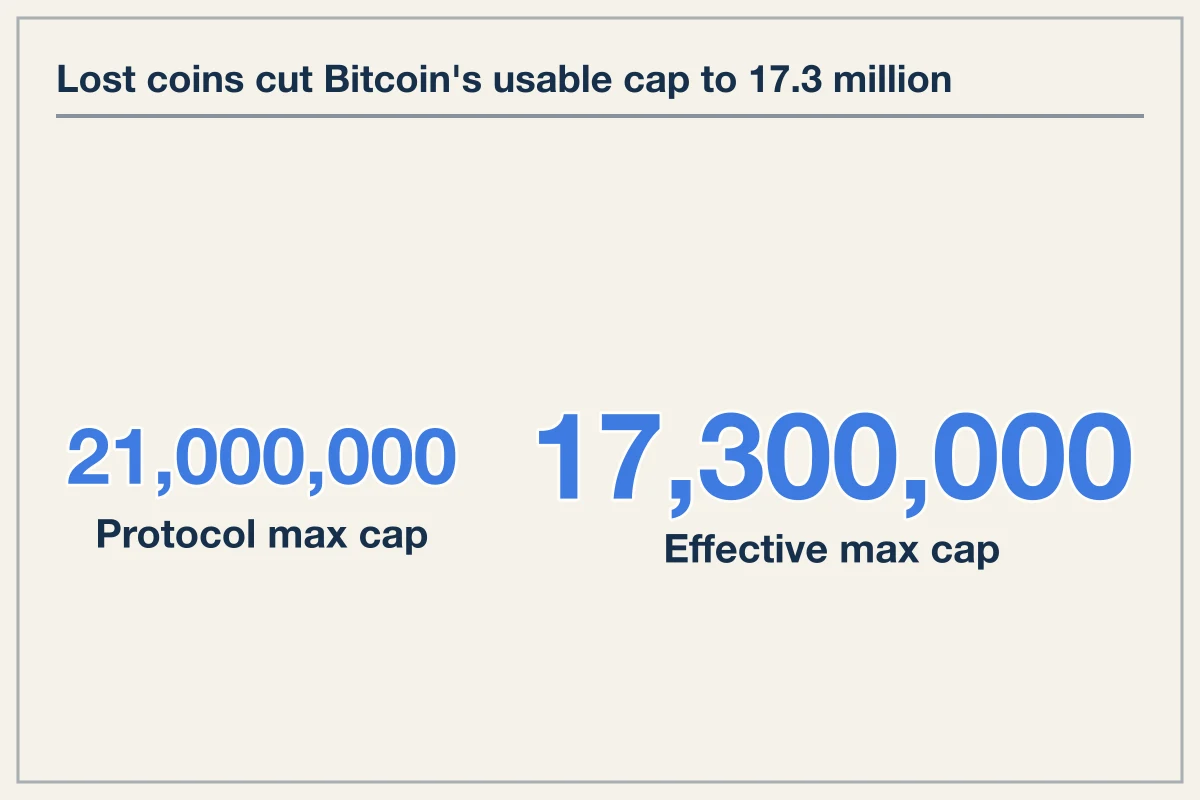
On-chain data cannot distinguish between a lost key and a long-term hold, leaving up to 3.7 million BTC permanently removed from actual circulating float.
An estimated 3.7 million Bitcoin are permanently inaccessible, reducing the effective total supply cap from 21,000,000 to approximately 17,300,000.
On-Chain Immobility and the Estimation Problem
The Bitcoin blockchain records unspent outputs, not balance sheets. When a transaction occurs, the protocol creates Unspent Transaction Outputs (UTXOs). A UTXO remains unspent until signed by the corresponding private key.
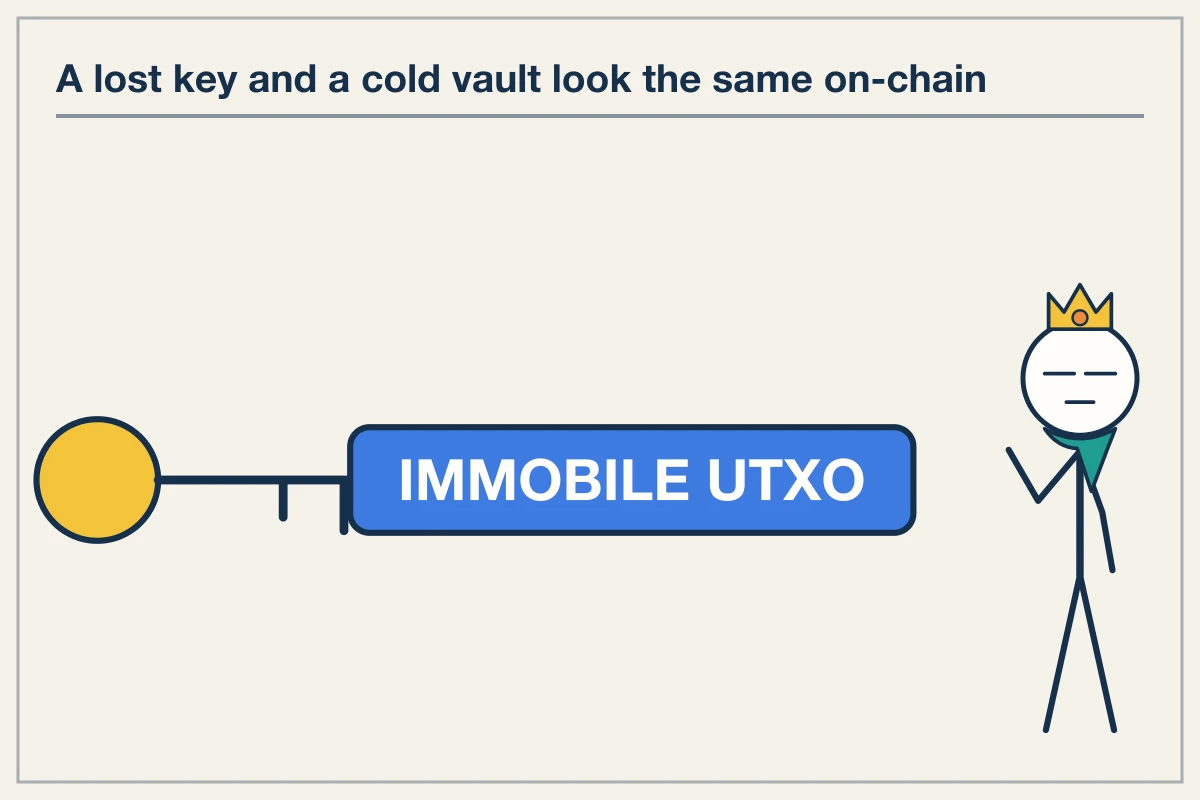
On-chain tracking cannot distinguish a lost private key from a cold storage vault held by an idle investor. Both appear as an immobile UTXO. Because the protocol never verifies whether a private key still exists in active memory, any figure for lost coins remains an estimate derived from UTXO age distributions and documented wallet destruction.
Documented Historical Coin Losses
A portion of the unspendable supply comes from verifiably destroyed addresses or confirmed lost credentials.
In November 2011, users created the address 1BitcoinEaterAddressWithoutOwnerX. The address has no private key. Blockchain records show 2,609 BTC sent to this burn address, rendering them mathematically unspendable.
In 2011, developer Stefan Thomas lost access to an IronKey encrypted drive containing an estimated 7,000 BTC after exhausting eight of ten password attempts.
In mid-2013, IT worker James Howells discarded a hard drive containing private keys for an estimated 7,500 BTC mined in 2009. The drive was buried in a municipal landfill in Newport, Wales.
The largest single cluster of dormant coins belongs to the early miner known as Patoshi. Between January 2009 and mid-2010, this miner accumulated an estimated 1,100,000 BTC across early block rewards. None of these outputs have moved since creation.
| Category / Event | Year | Estimated Volume (BTC) | Status |
|---|---|---|---|
| Patoshi Mining Cluster | 2009–2010 | 1,100,000 | Dormant since creation |
| Proof of Burn (1BitcoinEater) | 2011 | 2,609 | Verifiably unspendable |
| Stefan Thomas IronKey | 2011 | 7,000 | Lost credentials |
| James Howells Landfill | 2013 | 7,500 | Physical destruction |
| Broad UTXO Dormancy (>7 years) | 2009–2017 | 2,580,000 | Estimated lost supply |
Impact on Quoted Circulating Supply
Market cap aggregators calculate valuation by multiplying spot price by total minted coins. Approximately 19,700,000 BTC have been mined to date. Subtracting the estimated 3,700,000 lost coins leaves an active circulating float of roughly 16,000,000 BTC.
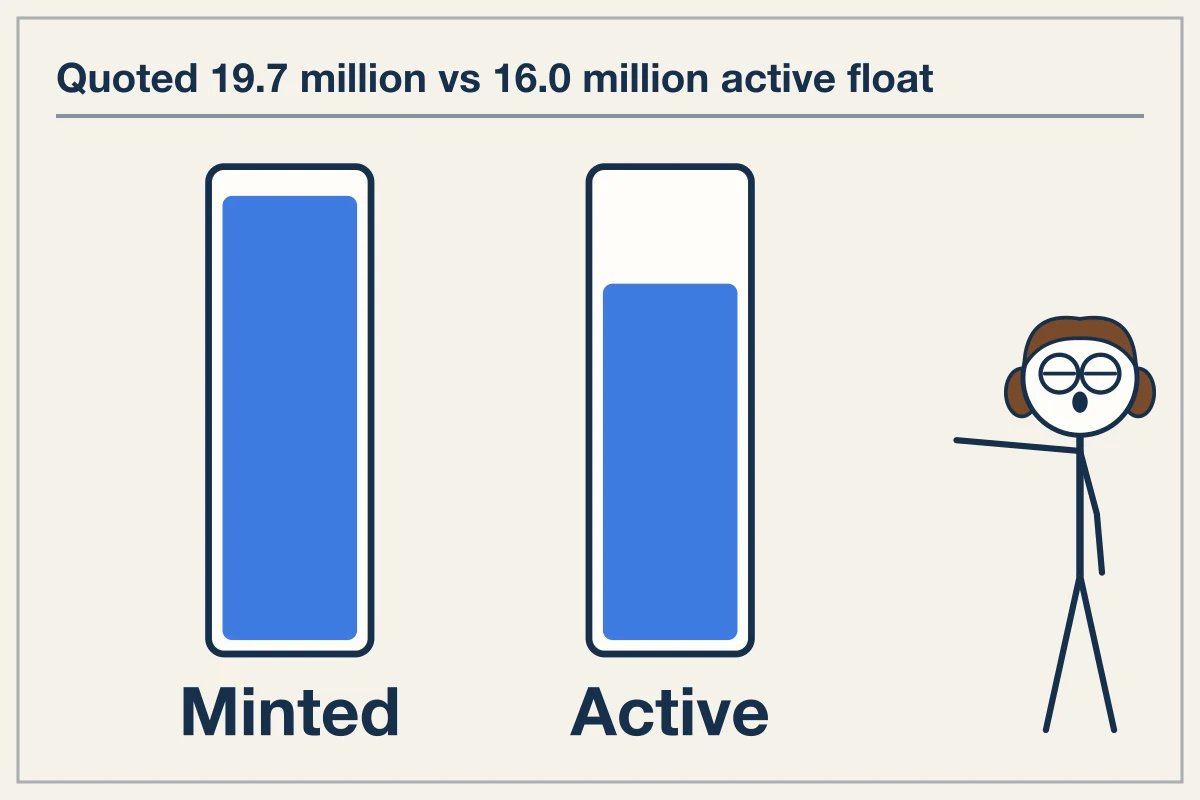
When financial models evaluate liquidity, leverage concentration, and market impact using the reported 19.7 million figure, they overstate real market depth by approximately 18.7%. Order book depth and exchange reserves draw strictly from the 16.0 million active float, not the minted total.
Perpetual Futures Pricing and Inventory Drag
Because liquid supply is tighter than headline figures suggest, spot market absorption is lower than calculated under a 19.7 million float assumption. For perpetual futures traders, this structural supply tightness shows up in funding rate spreads across venues during directional pushes.
Current 8-hour BTC perpetual funding rates display a clear cost discrepancy for long positions.
| Exchange | 8h Funding Rate | Normalised 24h Rate | Futures Taker Fee | Futures Maker Fee | 24h Volume |
|---|---|---|---|---|---|
| Bybit | +0.0072% | +0.0216% | 0.0550% | 0.0200% | $2,074,171,557 |
| Bitget | +0.0072% | +0.0216% | 0.0300% | 0.0200% | Unlisted |
| OKX | +0.0098% | +0.0294% | 0.0500% | 0.0200% | Unlisted |
| MEXC | +0.0100% | +0.0300% | 0.0200% | 0.0000% | Unlisted |
The funding spread between Bybit (+0.0072%) and MEXC (+0.0100%) is 0.0028 percentage points per 8-hour interval.
Worked Position Calculation
Consider a trader holding a $100,000 BTC long perpetual position over a 30-day period.
On Bybit or Bitget:
- 8-hour funding rate: 0.0072%
- Daily funding rate: 3 x 0.0072% = 0.0216%
- 24-hour dollar charge: $100,000 x 0.000216 = $21.60
- 30-day cumulative funding drag: $21.60 x 30 = $648.00
On MEXC:
- 8-hour funding rate: 0.0100%
- Daily funding rate: 3 x 0.0100% = 0.0300%
- 24-hour dollar charge: $100,000 x 0.000300 = $30.00
- 30-day cumulative funding drag: $30.00 x 30 = $900.00
Holding a $100,000 long position on MEXC costs $8.40 more per day than on Bybit, resulting in a 30-day funding differential of $252.00 on identical position size.
When trading perps against an illiquid supply baseline, venue selection dictates the carry cost of holding spot-equivalent exposure. If total available coins are capped at an effective 17.3 million, order book slippage and venue-level funding imbalances compound faster during supply squeezes than market models assume.