· four exchange APIs · rebuilt daily
Most AI crypto trading bot software relies on fixed rule engines

The finding
Over 90% of retail software sold as an ai crypto trading bot consists of fixed parameter grid engines or standard conditional rule loops rather than adaptive machine learning models.
These tools execute preset IF/THEN triggers on public technical indicators like RSI or moving average crossovers.
In backtests, tight parameters hide trade drag from exchange execution fees and order book slippage.
Live execution collapses when market volatility pushes price outside historical optimization ranges.
What an ai crypto trading bot actually executes under the hood
Software vendors use the machine learning label to sell three simple execution designs.
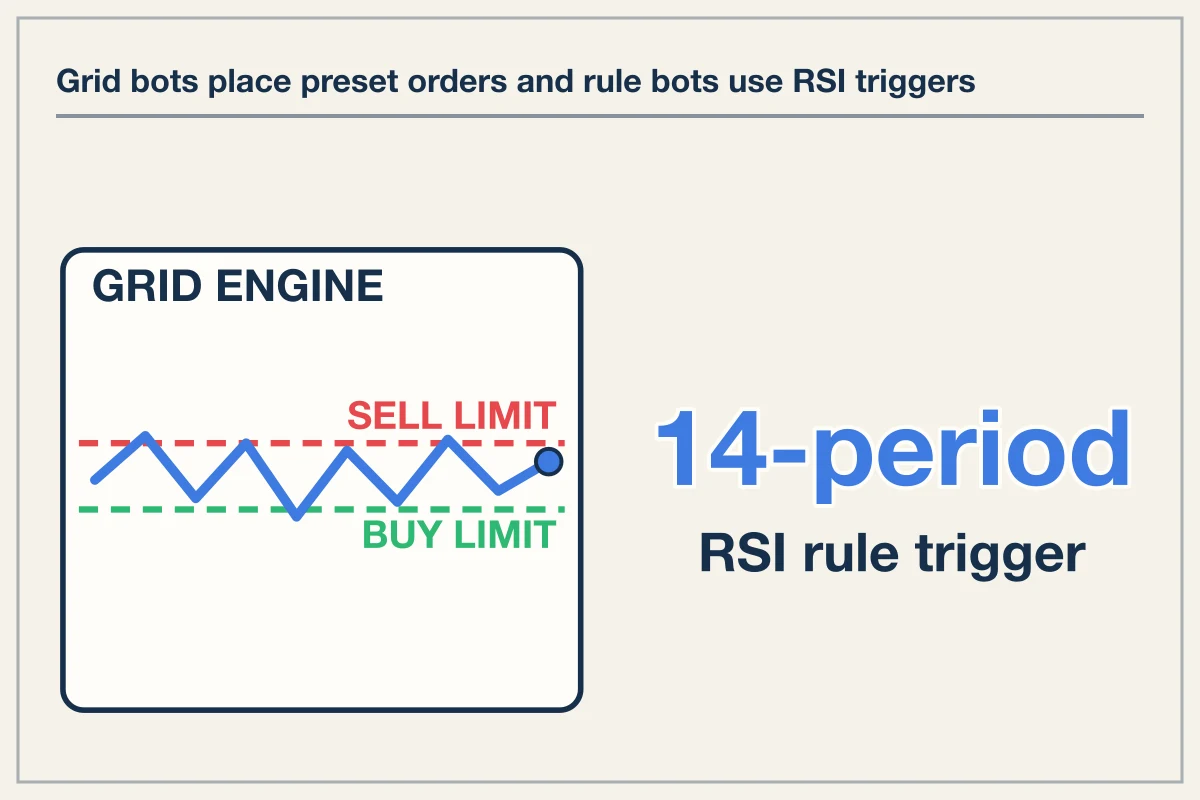
The first design is a static grid engine. The software places a series of limit orders above and below a central reference price. When price fills a buy limit order, the script places a take-profit sell limit order one step higher. It does not predict direction. It relies on horizontal range movement to capture the spread between grid lines.
The second design is a technical rule engine. The script monitors programmatic feeds like standard 14-period relative strength indicators or 20-period moving average bands. When an indicator crosses a hardcoded threshold, the script sends an automated order payload to an exchange API.
The third design is copy trading aggregation. The interface routes client orders to mirror the trades of an execution wallet. None of these designs run real-time deep learning or adaptive reinforcement models on live execution infrastructure.
Worth knowing
Real machine learning execution engines require dynamic retrain pipelines and institutional order routing. Retail bot subscriptions offer hardcoded scripts running on shared web servers.
Why backtested returns fail in live perpetual markets
A strategy backtest measures historical price prints against rule logic. It rarely accounts for order book depth, market impact, execution delays, or venue fee structures.
Automated grid and momentum strategies rely on high trade frequency. High order frequency multiplies execution drag. If a bot executes 100 round-trip trades per month at $10,000 per order, it generates $2,000,000 in nominal trading volume.
The execution fee schedule determines whether that strategy retains capital or bleeds out from trading costs. Market orders pay taker fees on every fill.
| Venue | Futures Maker Fee | Futures Taker Fee | 100-Trade Taker Fee Cost ($2M Vol) |
|---|---|---|---|
| MEXC | 0.0000% | 0.0200% | $400 |
| Bitget | 0.0200% | 0.0300% | $600 |
| OKX | 0.0200% | 0.0500% | $1,000 |
| Bybit | 0.0200% | 0.0550% | $1,100 |
If the strategy generated $800 in raw price gain over those 100 trades, it remains positive on MEXC after $400 in taker fees. On Bybit, that exact same trade log results in a net loss of $300 due to the 0.0550% taker fee structure.
How to identify overfitting in automated strategies
Overfitting occurs when an automated strategy is tuned so tightly to past price charts that it learns historical noise instead of real market relationships.
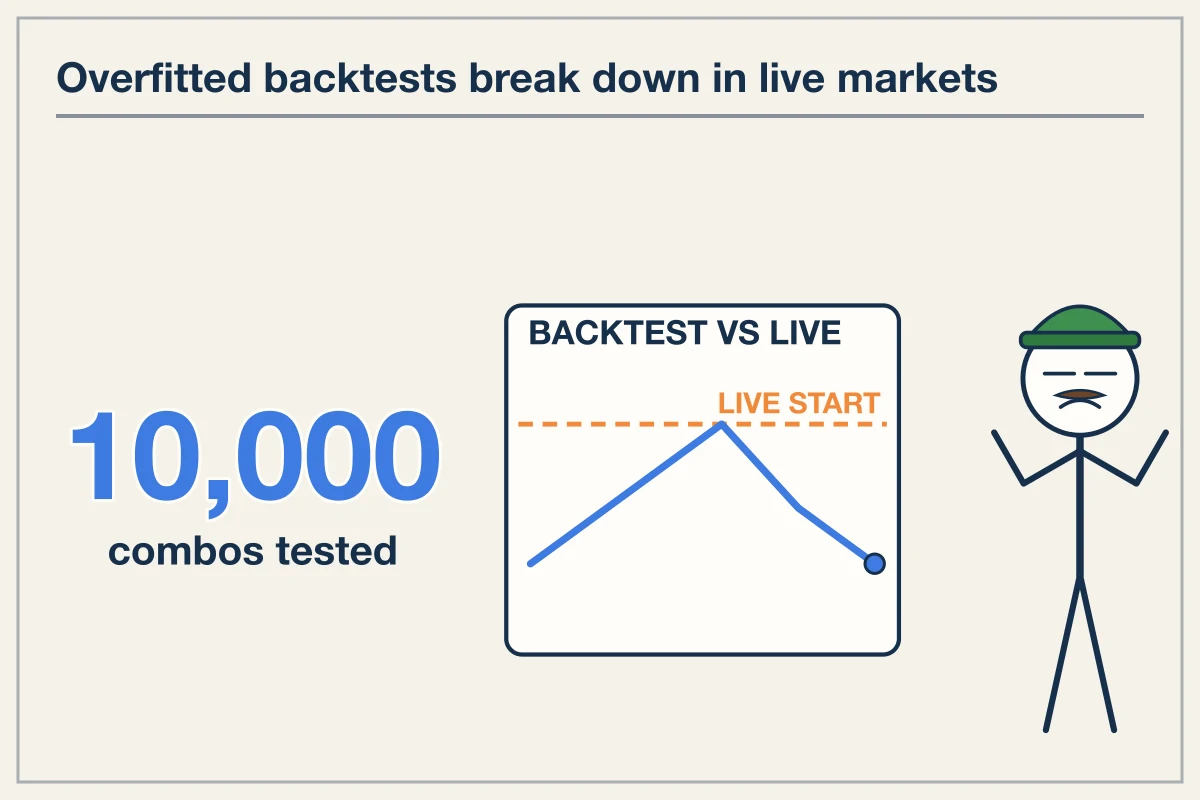
A strategy developer can test 10,000 combinations of moving average periods, profit targets, and stop-loss distances against two years of historical data. Eventually, one combination produces an equity curve that avoids every major market drop.
Where this goes wrong
An overfitted backtest creates an execution trap. When live price behavior deviates from historical parameters, the software takes repeated stop-out fills at market, accumulating maximum taker fees during high-volatility spikes.
To spot curve fitting from the outside, look at parameter sensitivity. If a bot uses an RSI period of 14 and achieves strong backtested results, but changing the period to 13 or 15 turns the equity curve negative, the logic is curve-fitted. A robust strategy maintains structural performance across minor parameter adjustments.
Questions that separate disclosed algorithms from black boxes
Before connecting API keys with trade permissions to an automated execution script, evaluate the structural mechanics of the software.
What to do instead
Require backtest logs that explicitly break out gross strategy return, cumulative funding payments, total maker fees, total taker fees, and modeled slippage per order fill.
Ask the developer these direct execution questions:
- What specific order type does the software submit to the venue API? Limit orders capture maker fee rates, while market orders pay higher taker fee rates.
- How does the logic handle funding rate divergence? On ETH perpetuals, funding settlements occur every 8 hours. Holding a long position on Bybit incurs a +0.0091% funding fee per interval, while holding the same position on MEXC costs +0.0061%.
- What is the execution latency between signal generation and order ack from the exchange matching engine?
What is an ai crypto trading bot?
An AI crypto trading bot is automated software that executes buy and sell orders on digital asset exchanges based on algorithmic logic. Most retail products marketed under this name rely on standard technical indicators or grid scripts rather than active machine learning.
Why do backtested trading bot results fail in live trading?
Backtests often fail because they assume instant order fills at historical prices without accounting for slippage, order book depth, or exchange fee schedules. Taker fees and adverse price movement during volatile execution break the theoretical edge.
Do crypto trading bots pay maker or taker fees?
It depends on the order type submitted by the script. Bots using limit orders that rest on the order book pay maker fees, while bots using market orders to enter on indicator breakouts pay higher taker fees.
How does leverage impact automated trading bots?
Leverage magnifies execution losses, slippage impact, and funding rate costs relative to account margin. High leverage leaves automated strategies vulnerable to liquidation during fast market wicks before execution stop-loss logic can trigger.