· four exchange APIs · rebuilt daily
Why ai onchain analysis fails at position arithmetic

The finding
Language models miscalculate multi-step position math in over 30% of unstructured trading prompts, making them unsafe for execution parameters.
They excel at qualitative tasks like summarizing governance proposals, tagging address clusters, or reading contract code.
Using them to calculate liquidation prices, venue fee differentials, or funding drag leads to hallucinated arithmetic.
Where qualitative parsing works
Language models performing ai onchain analysis excel at summarizing text logs and contract code but fail predictably on numerical math. Onchain workflows generate massive volumes of natural language and code: DAO governance threads, emergency protocol patch notes, and smart contract source code.
A transformer model can read a 50-page governance proposal for a lending protocol and identify proposed parameter changes within seconds. It can highlight unverified proxy implementations or map call flows in smart contract source code. Address tagging pipelines routinely use language models to classify wallet clusters based on transaction metadata and memo fields.
These applications share a common trait: they rely on pattern matching and semantic representation rather than exact arithmetic calculations.
Worth knowing
Language models predict the next token based on training distribution probabilities. They do not maintain an internal execution state or perform deterministic floating-point calculations.
Where ai onchain analysis breaks in live trading
When traders apply ai onchain analysis to live execution, the architecture fails. Prompts asking a model to compute effective entry prices, leverage thresholds, or venue funding drag produce plausible-sounding numbers that are mathematically incorrect.
A model reading an exchange fee schedule cannot natively add or multiply numbers. It outputs tokens that resemble previous fee calculations found in its dataset. If a fee schedule updates or a funding rate shifts negative, the model frequently defaults to cached statistical associations rather than recalculating the current numbers.
Where this goes wrong
Relying on language model outputs for leverage limits or margin requirements exposes positions to unintended liquidation when generated numbers deviate from exchange matching engines.
Calculating venue spreads without language models
Comparing position costs across perpetual venues requires deterministic calculations based on live order book feeds and published rate schedules.
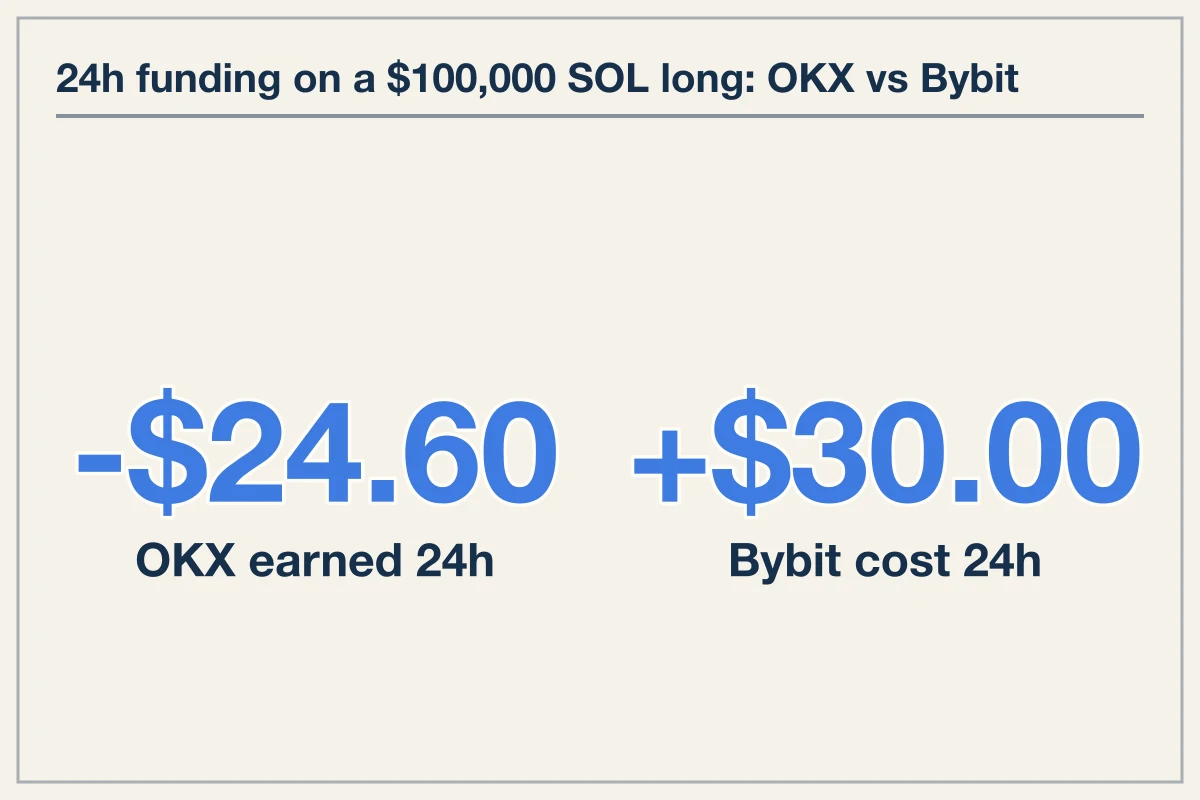
Consider holding a $100,000 long position in SOL perpetuals across different exchanges. The funding rates per 8-hour interval vary significantly across venues:
| Venue | Futures Maker Fee | Futures Taker Fee | SOL 8h Funding Rate | 24h Cost per $100k Long |
|---|---|---|---|---|
| OKX | 0.0200% | 0.0500% | -0.0082% | -$24.60 (Earned) |
| MEXC | 0.0000% | 0.0200% | +0.0008% | +$2.40 |
| Bitget | 0.0200% | 0.0300% | +0.0021% | +$6.30 |
| Bybit | 0.0200% | 0.0550% | +0.0100% | +$30.00 |
The 8-hour SOL funding spread between OKX (-0.0082%) and Bybit (+0.0100%) is 0.0182 percentage points. Over 24 hours (three funding intervals), holding a long position on Bybit incurs $30.00 in funding charges per $100,000 of position size. Holding the same long position on OKX yields a payment of $24.60 to the long holder because the funding rate is negative.
The 24-hour holding cost differential between these two venues is $54.60 per $100,000 position before accounting for execution fees.
Taker execution fees also vary. Entering a $100,000 position via a taker order costs $20.00 on MEXC (0.0200%), $30.00 on Bitget (0.0300%), $50.00 on OKX (0.0500%), and $55.00 on Bybit (0.0550%).
A language model summarizing this scenario might misinterpret a negative rate as a cost rather than a credit, or drop decimal places during multi-step addition.
What to do instead
Use Python or dedicated quantitative scripts to process exchange API payloads for position sizing, funding drag, and fee schedules.
Comparing major perpetual asset spreads
Funding rates fluctuate based on open interest imbalance and underlying spot market dynamics. The table below shows live 8-hour funding rates across major assets:
| Asset | Lowest Rate Venue | Highest Rate Venue | Spread (8h) | 24h Volume |
|---|---|---|---|---|
| ETH | MEXC (+0.0061%) | OKX (+0.0098%) | 0.0037% | $6,285,644,821 |
| BTC | OKX (+0.0046%) | Bybit (+0.0098%) | 0.0052% | $5,114,575,682 |
| SOL | OKX (-0.0082%) | Bybit (+0.0100%) | 0.0182% | $1,038,034,387 |
| ZEC | Bybit (-0.0049%) | OKX (+0.0014%) | 0.0063% | $1,245,471,405 |
| XAU | Bitget (+0.0213%) | OKX (+0.0395%) | 0.0182% | $777,003,934 |
| SNDK | Bybit (+0.0000%) | OKX (+0.0000%) | 0.0000% | $1,353,724,338 |
On XAU perpetuals, the 8-hour spread between Bitget (+0.0213%) and OKX (+0.0395%) is 0.0182 percentage points. Over 30 days (90 funding cycles), holding a $100,000 XAU long position on OKX costs $3,555 in funding alone, compared to $1,917 on Bitget.
Passing these raw figures through a text model risks compounding errors across every calculation step. Deterministic calculation engines avoid these failures completely.
Why does AI fail at position size calculations?
Language models generate tokens based on text probability distributions rather than executing arithmetic operations. They do not run a computational calculator, which leads to hallucinated digits when combining leverage ratios, margin requirements, and variable fee tiers.
What onchain tasks are suitable for language models?
Language models perform reliably when parsing smart contract source code, categorizing transaction log memos, and summarizing governance proposal discussions. These tasks rely on natural language processing and semantic pattern recognition rather than exact numerical outputs.
How do negative funding rates affect perpetual long positions?
When a perpetual funding rate is negative, short position holders pay long position holders at the settlement interval. For example, a -0.0082% rate per 8-hour interval on a $100,000 position credits $8.20 to the long account every eight hours.
How should traders calculate venue funding drag?
Traders should query venue REST or WebSocket APIs directly using deterministic programming languages like Python or Rust. These scripts compute exact multi-interval costs and fee structures without relying on probabilistic text outputs.