· four exchange APIs · rebuilt daily
Leverage crypto futures explained by distance to liquidation
The finding
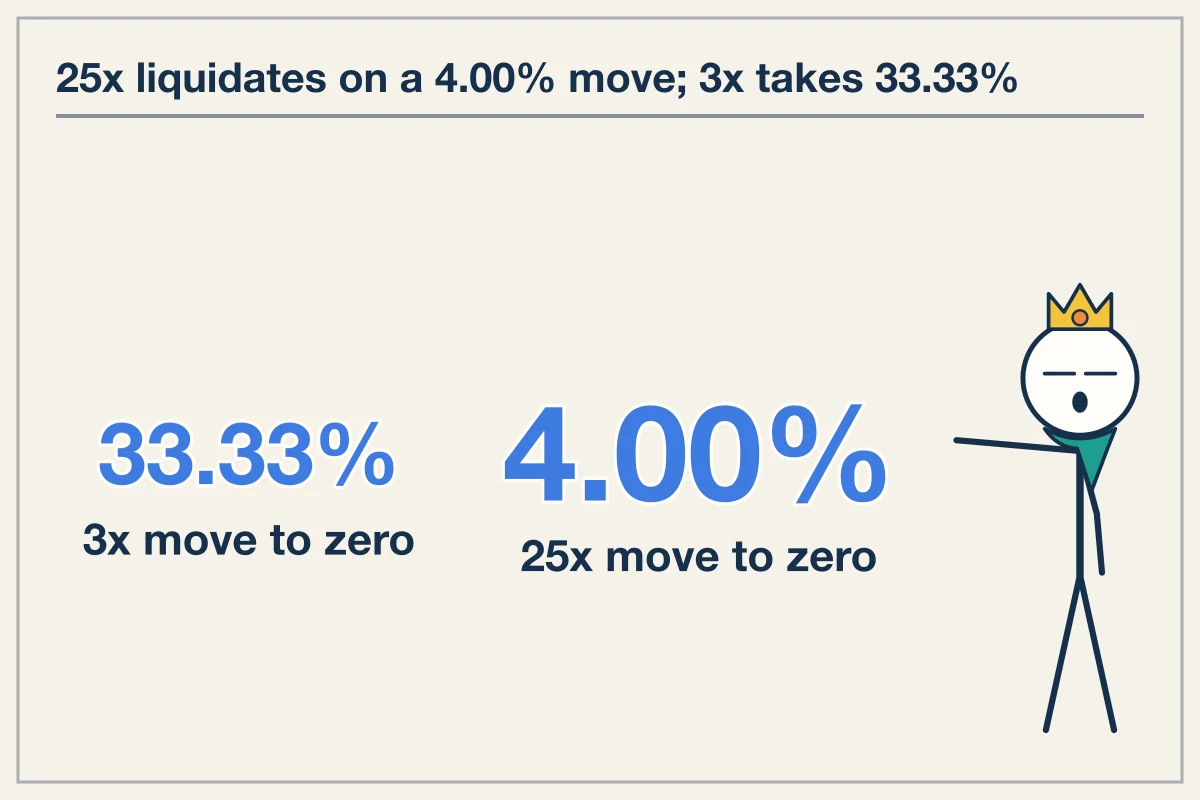
At 25x leverage, a position reaches liquidation on a 4.00% adverse price move, compared to 33.33% at 3x leverage.
Position sizing determines dollar exposure while leverage strictly controls buffer distance.
Holding higher leverage compresses the price movement required for complete position loss.
With leverage crypto futures explained by margin requirements rather than payout multipliers, leverage acts strictly to shorten liquidation distance. Understanding how leverage crypto futures explained mechanics operate reveals that higher leverage compresses tolerance for price drawdowns.
When opening a perpetual futures contract, initial margin defines the collateral deposited relative to total nominal position size. At 1x leverage, initial margin is 100.00%. Increasing leverage reduces the required collateral percentage proportionately. At 3x leverage, initial margin drops to 33.33%. At 10x leverage, initial margin is 10.00%. At 25x leverage, initial margin requires only 4.00% of the total position value.
Without accounting for maintenance thresholds, the maximum adverse move before account equity reaches zero equals 100% divided by leverage. At 3x leverage, a position tolerates a 33.33% adverse price move. At 10x leverage, that buffer shrinks to 10.00%. At 25x leverage, a 4.00% price move fully consumes posted collateral.
Worth knowing
Maintenance margin rules mean position liquidation occurs before account equity reaches zero, preserving funds for venue closing fees.
How leverage crypto futures explained by liquidation distance works
Exchanges enforce maintenance margin thresholds to liquidate positions before account balances turn negative. If a venue applies a standard 0.50% maintenance margin requirement, liquidation triggers when remaining margin equity drops to 0.50% of total position value.
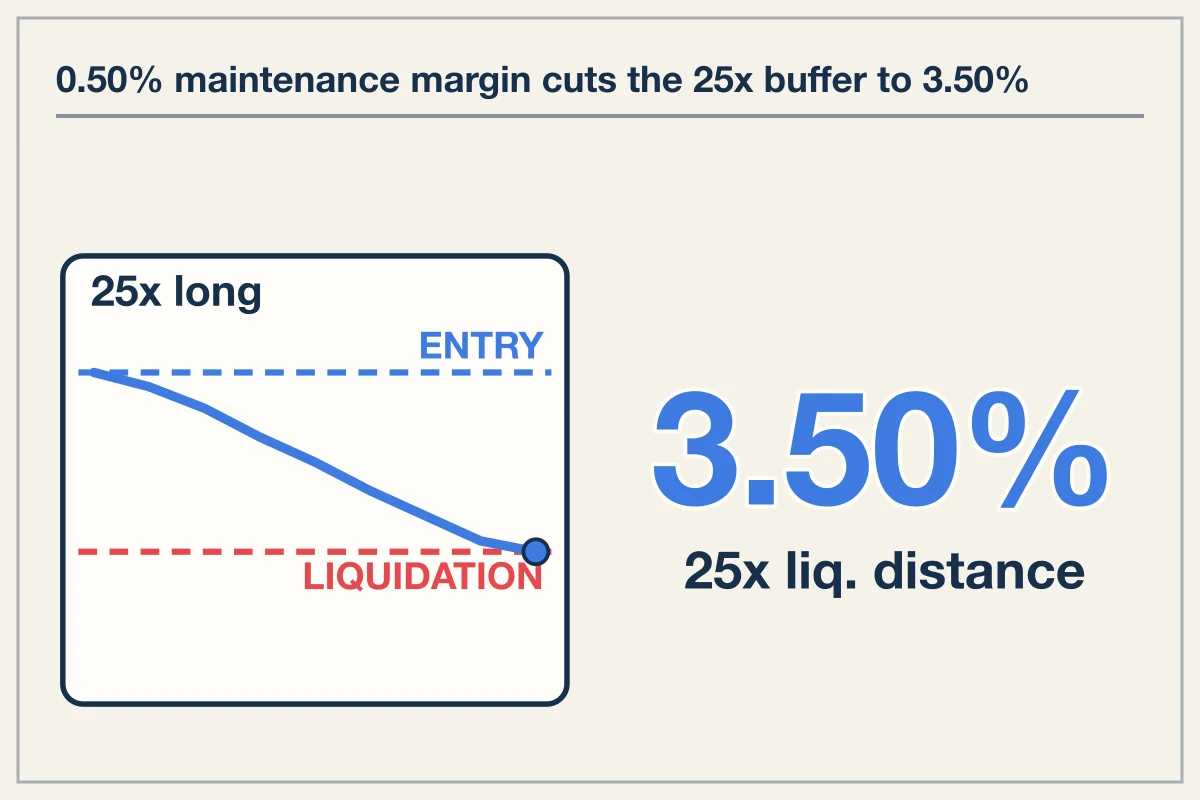
At 3x leverage, subtracting the 0.50% maintenance threshold leaves a 32.83% price drawdown buffer. At 10x leverage, the buffer shrinks to 9.50%. At 25x leverage, position buffer narrows to 3.50%.
| Leverage | Initial Margin | Zero Equity Distance | Liquidation Distance (0.50% MM) |
|---|---|---|---|
| 3x | 33.33% | 33.33% | 32.83% |
| 10x | 10.00% | 10.00% | 9.50% |
| 25x | 4.00% | 4.00% | 3.50% |
Position sizing sets total dollar risk, while leverage dictates how close entry sits to liquidation. A $100,000 nominal position built with $33,333 collateral at 3x leverage has identical dollar exposure to a $100,000 position built with $4,000 collateral at 25x leverage. However, the 25x position gets liquidated on a 3.50% price move, whereas the 3x position survives a 32.83% decline.
Venue fee structures and margin decay
Leverage multiplies execution fees relative to deposited collateral because fees apply to nominal position size. On a $100,000 position with $4,000 collateral at 25x leverage, fee impact scales significantly across exchange schedules.
| Exchange | Futures Taker Fee | Futures Maker Fee | BTC 8h Funding Rate | BTC 24h Funding Drag |
|---|---|---|---|---|
| MEXC | 0.020% | 0.000% | +0.0065% | +0.0195% |
| Bitget | 0.030% | 0.020% | +0.0077% | +0.0231% |
| OKX | 0.050% | 0.020% | +0.0046% | +0.0138% |
| Bybit | 0.055% | 0.020% | +0.0098% | +0.0294% |
Opening and closing a $100,000 position on Bybit at market costs 0.055% per side, totaling $110 in taker fees. This fee expense removes 2.75% of the $4,000 initial margin before market movement occurs. On MEXC, round-trip taker fees equal $40, consuming 1.00% of collateral.
Funding payments further reduce available margin over time. Holding a $100,000 long BTC position on Bybit incurs an 8-hour rate of +0.0098%, costing $29.40 daily. Over 24 hours, this funding drag subtracts 0.735% from the $4,000 collateral buffer. On OKX, where funding is +0.0046%, daily funding drag totals $13.80, consuming 0.345% of margin collateral.
Where this goes wrong
Taker execution fees and daily funding rates drain margin collateral rapidly when calculated against large nominal position sizes.
Volatility bounds and altcoin carrying costs
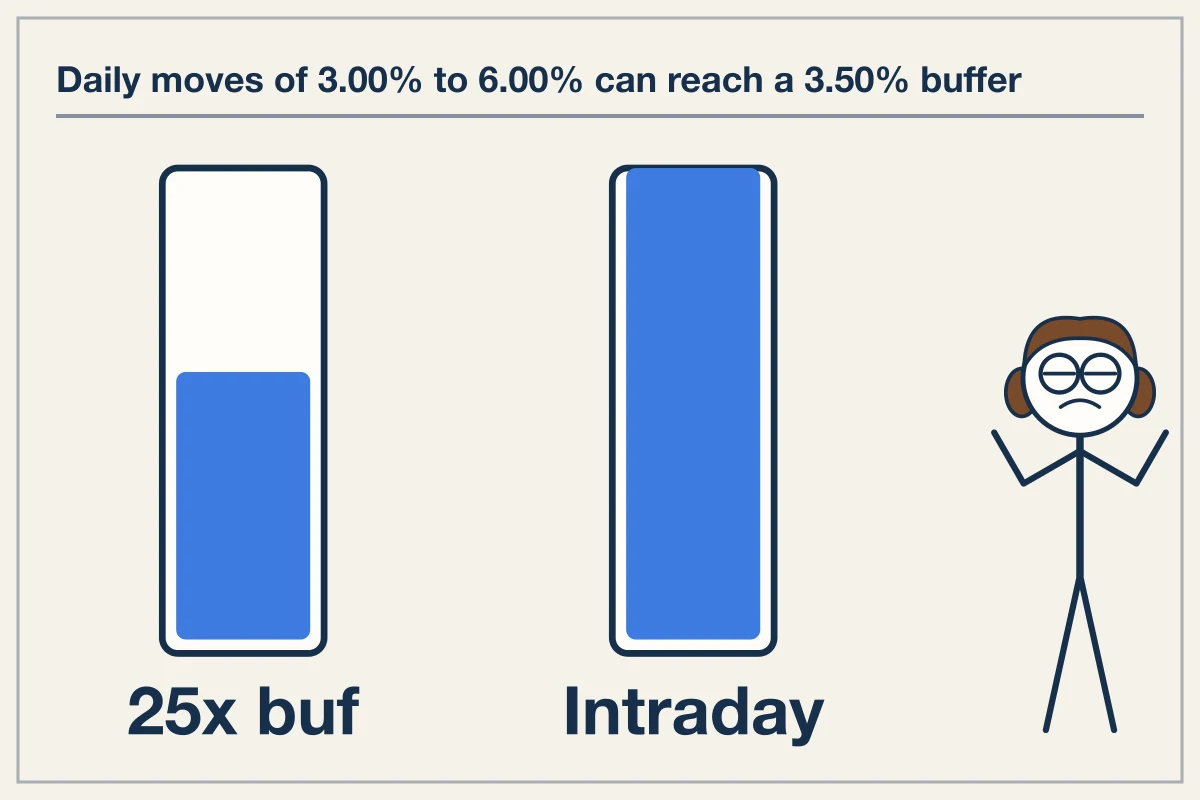
Crypto asset volatility frequently surpasses high-leverage liquidation bounds during routine trading hours. Standard intraday price moves on major tokens range between 3.00% and 6.00%. A 25x leveraged position with a 3.50% liquidation distance will trigger liquidation during normal market noise without any sustained trend reversal.
What to do instead
Reduce leverage multipliers to widen liquidation buffers beyond ordinary intraday price volatility bands.
Carrying costs vary sharply across non-BTC assets. On Solana (SOL), OKX features a negative funding rate of -0.0083% per 8 hours, paying long position holders $24.90 daily per $100,000 nominal size. Conversely, Bybit charges long SOL holders +0.0100% per 8 hours, taking $30.00 daily per $100,000 position.
Gold perpetual contracts (XAU) carry higher structural funding costs across platforms. OKX charges +0.0395% per 8 hours for XAU perps. Holding a $100,000 nominal long XAU position on OKX costs $118.50 daily in funding. At 25x leverage, paying $118.50 daily removes 2.96% of initial margin every 24 hours purely to hold the trade open.
What is the liquidation distance at 25x leverage?
At 25x leverage, maximum price drawdown before reaching zero margin equity is 4.00%. Accounting for a standard 0.50% maintenance margin requirement, position liquidation triggers after a 3.50% adverse price move.
How do trading fees impact high leverage collateral?
Execution fees apply to total nominal position size rather than deposited collateral. A 0.050% taker fee on a $100,000 position costs $50, which equals 2.50% of initial margin on a 25x leveraged trade requiring $4,000 collateral.
Which venue has the lowest BTC funding rate for long positions?
OKX currently maintains the lowest BTC 8-hour funding rate for long positions at +0.0046%, compared to +0.0065% on MEXC, +0.0077% on Bitget, and +0.0098% on Bybit.
Why does high leverage increase liquidation risk during normal market volatility?
High leverage compresses liquidation distance to single-digit percentage moves. Normal daily price noise across crypto markets frequently exceeds 3.00% to 5.00%, triggering forced liquidations on standard intraday fluctuations.