· four exchange APIs · rebuilt daily
The hidden costs of crypto trading often exceed published fees
The finding
Crossing the taker spread and paying funding rate differentials can cost over 0.11% round-trip before market slippage is applied.
Published taker fees range from 0.02% to 0.055% across major perpetual exchanges.
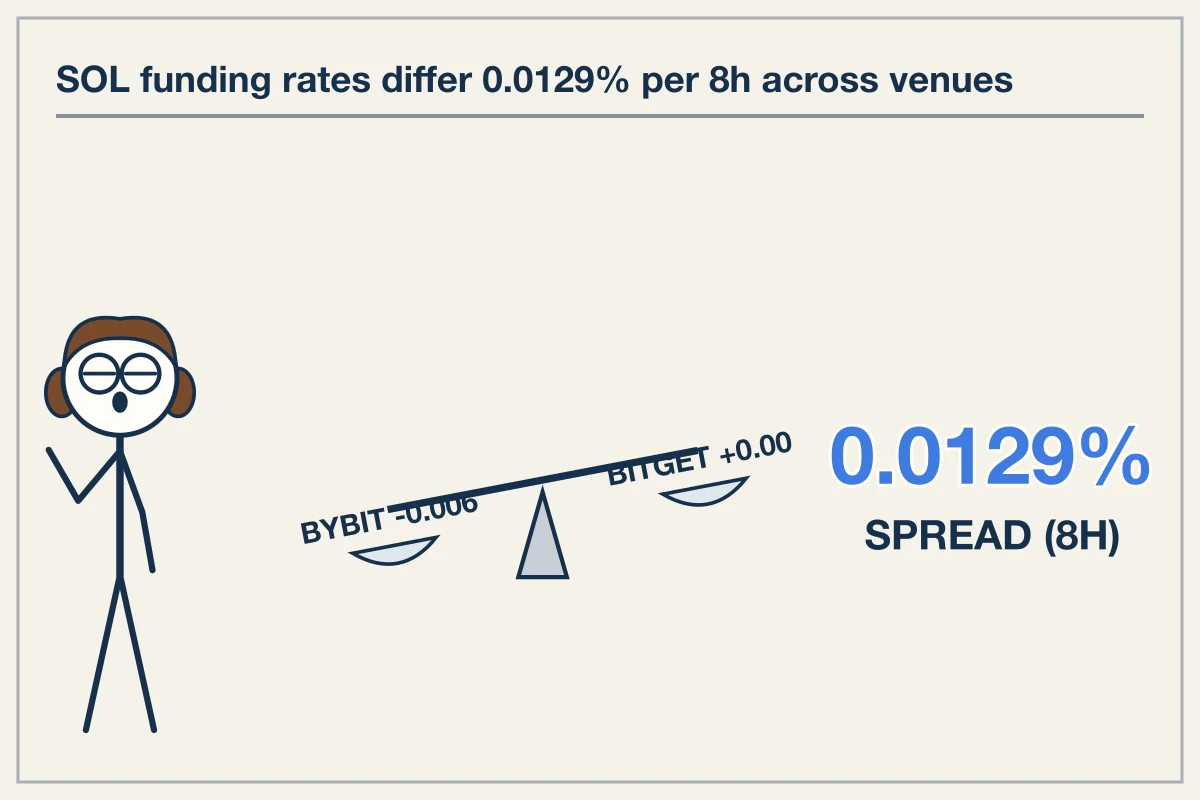
Live SOL funding rates vary by 0.0129% per eight hours between Bybit and Bitget.
Holding a position for one month across the wrong venue creates a multi-percent drag on capital.
The hidden costs of crypto trading start at execution
Traders evaluating perpetual futures venues frequently focus on published fee tiers. The hidden costs of crypto trading begin immediately when executing market orders that cross the bid-ask spread.
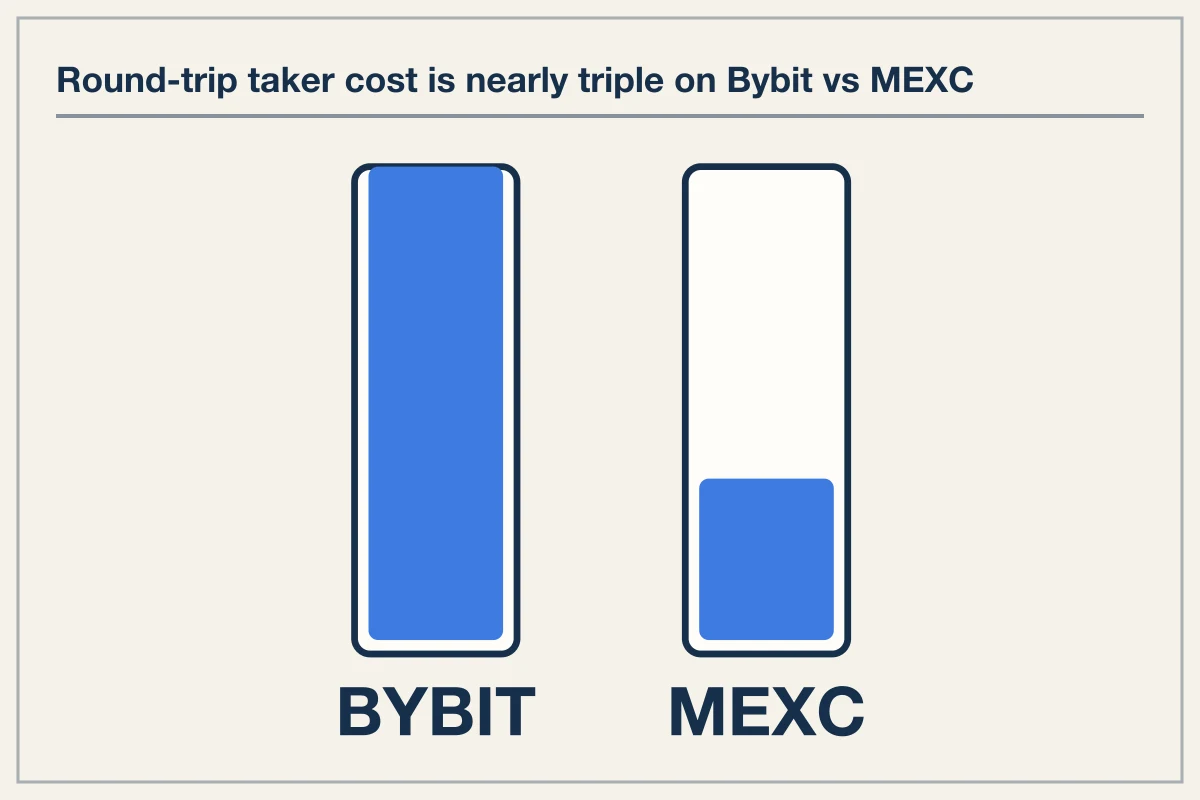
Every execution incurs a fee based on order type, but entry and exit costs compound based on exchange structure. Entering a trade with a market order pays the taker fee, while closing with a market order pays it again. On Bybit, default futures taker fees are 0.055%, generating a round-trip baseline execution cost of 0.110%. On MEXC, the futures taker fee is 0.020%, resulting in a round-trip baseline execution cost of 0.040%. On OKX, taker fees sit at 0.050% for a round-trip cost of 0.100%, while Bitget charges 0.030% for a round-trip cost of 0.060%.
| Venue | Spot Maker Fee | Spot Taker Fee | Futures Maker Fee | Futures Taker Fee | Round-Trip Futures Taker |
| Bitget | 0.100% | 0.100% | 0.020% | 0.030% | 0.060% |
| Bybit | 0.100% | 0.100% | 0.020% | 0.055% | 0.110% |
| MEXC | 0.000% | 0.050% | 0.000% | 0.020% | 0.040% |
| OKX | 0.080% | 0.100% | 0.020% | 0.050% | 0.100% |
A position opened and closed via market orders on Bybit costs nearly triple the fee drag of the same execution sequence on MEXC before accounting for spread width or market depth.
Market impact and order book depth
Order execution costs extend beyond nominal schedule tiers into book depth. A limit order posted to the book earns maker rates, set at 0.020% on Bitget, Bybit, and OKX, and 0.000% on MEXC. However, market orders execute against existing limit orders. If an order size exceeds the volume available at the top of the book, the remaining order fills at progressively worse prices.
Where this goes wrong
Placing market orders into thin depth fills across multiple price levels, compounding base taker fees with structural slippage.
Slippage scales with position size and token liquidity. High-volume contracts like BTC, with $10,145,730,006 in 24-hour volume, absorb larger market orders with minimal price impact. Lower-volume contracts disperse fills across wider price intervals. The difference between the expected execution price and the actual average fill price represents an unstated cost that does not appear on fee schedules.
Funding rate differentials across venues
For positions held open past the settlement timestamp, perpetual funding rates represent the largest ongoing holding cost. Funding payments equilibrate perpetual contract prices with spot index prices. Every eight hours, longs pay shorts when rates are positive, and shorts pay longs when rates are negative.
| Asset | OKX Rate (8h) | Bybit Rate (8h) | MEXC Rate (8h) | Bitget Rate (8h) | Spread (8h) | 24h Volume |
| BTC | +0.0070% | +0.0070% | +0.0095% | +0.0100% | 0.0030% | $10,145,730,006 |
| ETH | +0.0100% | +0.0100% | +0.0100% | +0.0083% | 0.0017% | $9,001,484,418 |
| SOL | -0.0020% | -0.0061% | -0.0008% | +0.0068% | 0.0129% | $1,296,768,081 |
| ZEC | +0.0100% | +0.0100% | +0.0100% | +0.0098% | 0.0002% | $1,259,731,787 |
| XRP | +0.0100% | +0.0100% | +0.0100% | +0.0100% | 0.0000% | $859,713,669 |
Across assets, funding charges diverge significantly between exchanges. On SOL contracts, Bybit charges long positions -0.0061% per eight hours, meaning shorts pay longs 0.0061% per interval. On Bitget, the SOL rate is +0.0068%, requiring long traders to pay 0.0068% per interval. The resulting venue spread is 0.0129% every eight hours.
Over a 30-day period (90 settlement intervals), holding a long SOL position on Bitget accumulates a cumulative funding cost of 0.612%. Holding the same long position on Bybit yields a funding credit of 0.549%. The total divergence between these two choices equals 1.161% of total position value.
Calculating real position drag
Evaluating total exchange cost requires combining round-trip taker fees with funding trajectories over the target holding period.
What to do instead
Calculate total trade cost as round-trip taker fee plus expected funding over planned duration before selecting a venue.
On BTC contracts, live 8-hour funding stands at +0.0070% on OKX and Bybit, +0.0095% on MEXC, and +0.0100% on Bitget. A long BTC position held for 10 days (30 intervals) on OKX incurs 0.210% in funding costs plus 0.100% in round-trip taker fees, totaling 0.310% in mandatory drag. The same trade on Bitget incurs 0.300% in funding plus 0.060% in taker fees, totaling 0.360%. On MEXC, 0.285% in funding plus 0.040% in taker fees totals 0.325%.
Selecting a venue based solely on taker fees ignores the ongoing impact of funding rate variance. When holding positions across multiple settlement cycles, funding spreads dominate execution costs.
What are the main hidden costs of crypto trading?
Execution costs extend beyond published taker fees to include bid-ask spread crossing, order book slippage, and multi-venue funding rate spreads. Taker fees cover basic venue charges, but market impact on larger orders and ongoing funding payments often constitute the majority of total trade drag.
How do funding rate differences affect holding costs?
Perpetual futures funding rates vary by exchange, creating substantial cost gaps over time. On SOL contracts, 8-hour funding spreads reach 0.0129% between venues, resulting in a performance difference exceeding 1.16% over a 30-day holding period.
Why do taker fees vary across perpetual exchanges?
Exchange fee structures reflect baseline default tiers, with perpetual futures taker rates ranging from 0.020% on MEXC to 0.055% on Bybit. These differences result in default round-trip execution costs ranging from 0.040% to 0.110% before accounting for order book depth or slippage.
How does bid-ask spread impact round-trip trade costs?
Entering and exiting a position with market orders requires crossing the spread twice, paying the venue taker fee on both legs. On higher-volume assets like BTC or ETH, execution stays close to book prices, but lower liquidity contracts compound base taker fees with slippage across multiple price steps.