· four exchange APIs · rebuilt daily
How to read order book crypto depth and measure real execution slippage

The finding
Visible level-two order book depth on high-volume perp markets can vanish within milliseconds, leaving large market orders to sweep 0.05% to 0.20% deeper than the top bid or ask.
Learning how to read order book crypto depth requires looking beyond static bids and asks.
A resting limit order carries zero obligation until the matching engine matches it against an incoming market order.
Heavy bid-ask order book imbalances frequently indicate market maker risk positioning rather than genuine directional conviction.
Depth, Spread, and the Limits of Level Two
The bid-ask spread is the gap between the highest buyer and lowest seller. In high-volume perpetual markets, this spread tightens to a single price tick. ETH perpetuals settled 12,946,423,823 USD in 24-hour volume, while BTC reached 8,647,493,079 USD. At this volume, top-of-book quotes refresh continuously, but top-of-book size represents a fraction of market liquidity.
Level-two depth displays resting limit orders grouped by price level. Traders often treat this aggregated depth as a firm barrier. It is not. Order books reflect intention, not commitment. A resting order is a free option granted to the market. Algorithmic traders pull limit orders when aggressive market orders approach, causing the visible book to thin out instantly during fast moves.
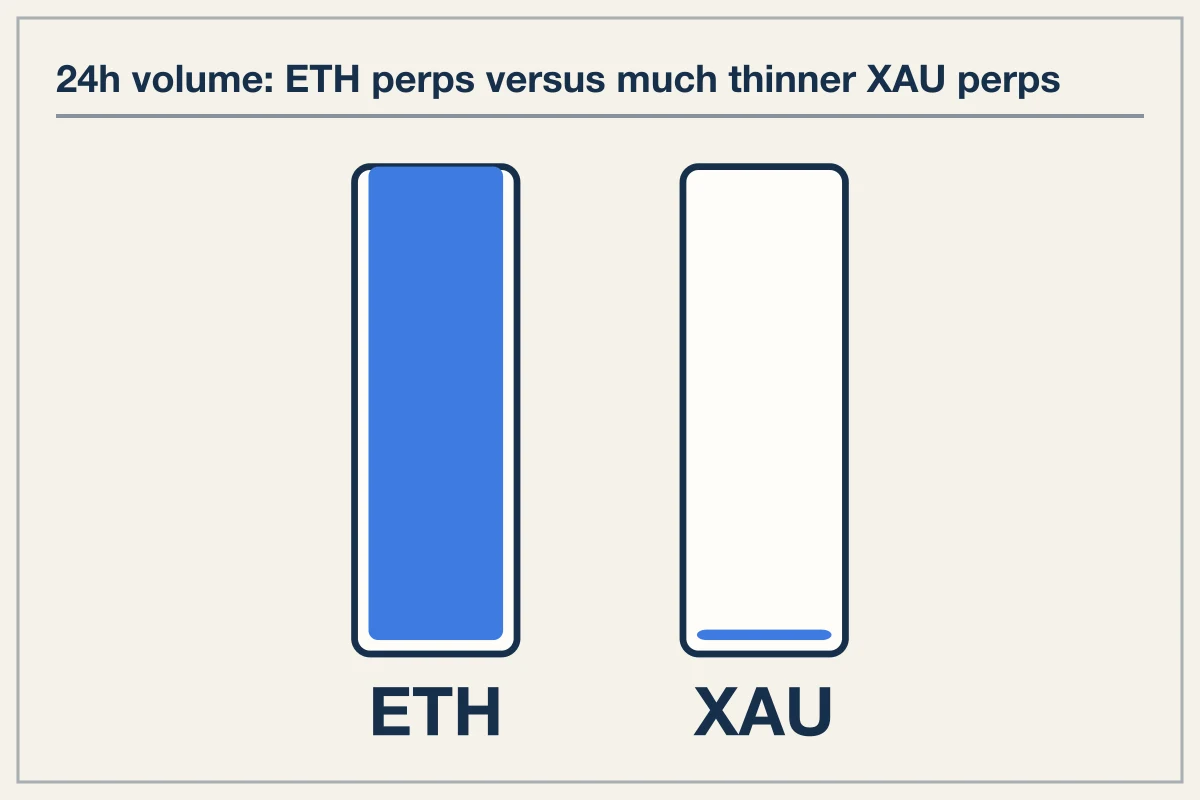
Lower-volume venues and altcoin perpetuals demonstrate how thin depth creates severe execution drag. ZEC recorded 1,734,123,664 USD in 24-hour volume across venues, while SNDK recorded 1,025,456,268 USD and XAU perpetuals cleared 686,319,400 USD. Crossing the spread on lower-volume books exposes market orders to multi-tick sweeps.
Where this goes wrong
Resting limit orders are non-binding. A 10,000 SOL bid wall can be canceled in a single API call ten milliseconds before a market sell order fills, leaving the seller to sweep lower bids.
How to Read Order Book Crypto Depth for Real Execution Cost
Evaluating market order fills requires summing available contract sizes through successive price levels until the entire order is filled. This yields the volume-weighted average fill price.
Consider an aggressive buy order for 100 ETH contracts when the top ask sits at 3,000.00 USD. The order book ask side shows three visible levels:
- Level 1: 10 ETH at 3,000.00 USD
- Level 2: 20 ETH at 3,000.50 USD
- Level 3: 70 ETH at 3,001.00 USD
The market buy clears Level 1 for 30,000.00 USD, Level 2 for 60,010.00 USD, and Level 3 for 210,070.00 USD. Total gross execution equals 300,080.00 USD for 100 ETH.
The volume-weighted average fill price is 3,000.80 USD per contract. Slippage adds 0.80 USD per ETH, or 0.0267% above the top ask. Venue fees apply on top of this filled price. On Bybit, the default futures taker fee of 0.055% adds 165.04 USD. Total execution penalty over the top-of-book quote reaches 245.04 USD.
What to do instead
Calculate total execution cost as volume-weighted average fill price plus venue taker fee before placing market orders into thin books.
Spoofing Mechanics and Order Book Imbalance
Order book imbalance compares total resting bid volume against total resting ask volume within a fixed distance from the mid-price, such as 1% or 2%. An imbalance ratio of 3:1 on the bid side appears bullish, suggesting strong buying interest.
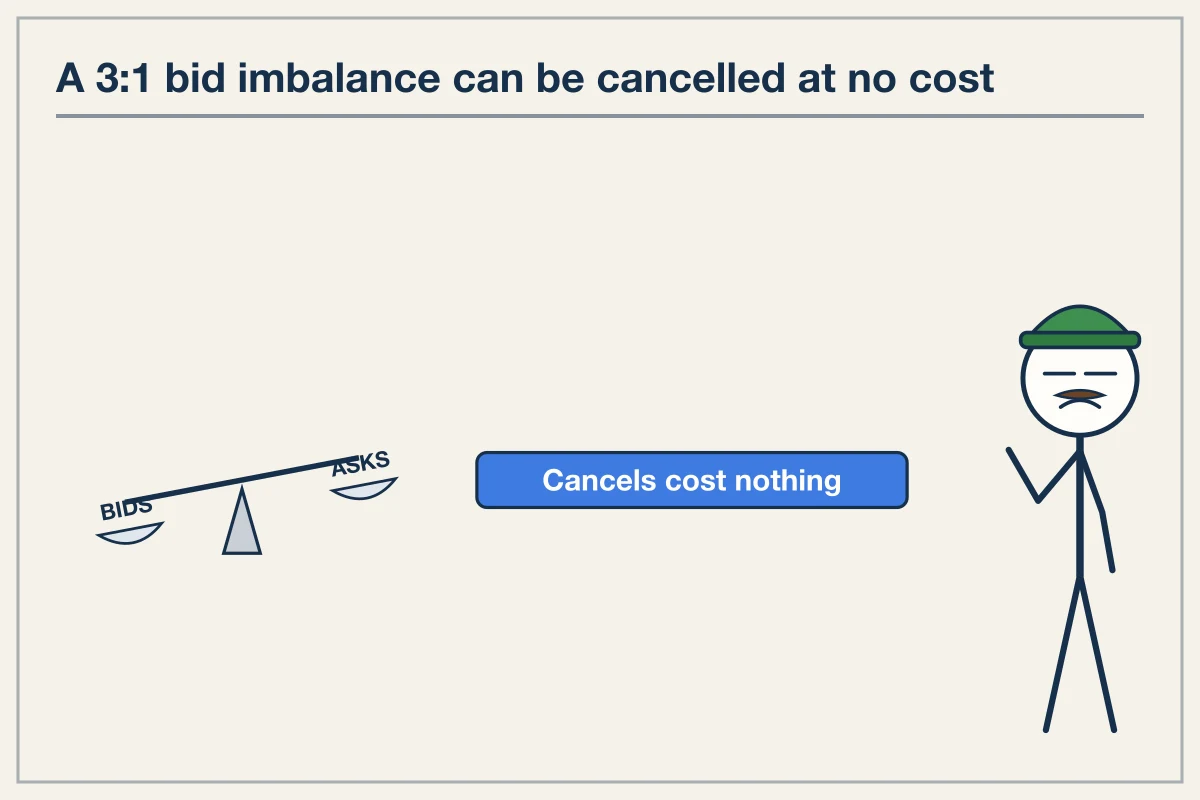
In practice, large resting limit orders are frequently used for spoofing. High-frequency trading algorithms place large bids to induce other traders to buy in front of them. When market orders approach those bids, the algorithm cancels them and submits sell orders into the inflated buying interest.
Because cancellations cost nothing on major crypto exchanges, resting order book depth carries low predictive power for price direction over horizons longer than a few seconds.
Worth knowing
Order book depth shows resting limit orders, while funding rates reflect net position bias. On SNDK perpetuals, Bitget funding sits at +0.0293% per 8h while Bybit sits at +0.0000% per 8h, showing how holding costs diverge across venues despite similar order book layouts.
Venue Fees and Liquid Depth Comparison
Exchange fee schedules dictate whether sweeping the order book is economically viable. Taker fees apply to every market order that consumes resting liquidity.
| Venue | Futures Maker Fee | Futures Taker Fee | Taker Fee on 100,000 USD Order |
|---|---|---|---|
| MEXC | 0.000% | 0.020% | 20.00 USD |
| Bitget | 0.020% | 0.030% | 30.00 USD |
| OKX | 0.020% | 0.050% | 50.00 USD |
| Bybit | 0.020% | 0.055% | 55.00 USD |
MEXC offers a 0.020% taker fee with a 0.000% maker fee, reducing execution drag for high-frequency strategies. Bybit charges a 0.055% taker fee, making market order sweeps nearly three times more expensive in fee terms before accounting for order book slippage.
How do you calculate slippage on a crypto order book?
Sum the volume available at each price level starting from the top bid or ask until the full position size is met. Divide the total transaction cost across those levels by the total position size to find the volume-weighted average price, then compare that result to the initial top-of-book price.
What does a large order book imbalance tell you?
It shows where market participants have submitted non-binding limit orders at a single point in time. It does not indicate future price direction because traders can cancel resting orders before an aggressive market order reaches the matching engine.
Why do bid walls disappear right before price hits them?
Automated trading programs place large resting limit orders to signal fake support, then cancel those orders milliseconds before market sells fill them. This practice avoids unwanted executions while manipulating short-term order flow.
Which venue has the lowest futures taker fee for market orders?
MEXC charges a 0.020% futures taker fee with a 0.000% maker fee. Bitget charges 0.030% taker, OKX charges 0.050% taker, and Bybit charges 0.055% taker on default fee schedules.