· four exchange APIs · rebuilt daily
How funding rate arbitrage eats profits through trading fees

The finding
Realised returns from funding rate arbitrage fall 0.10% to 0.31% below headline spreads due to execution fees and rebalancing costs.
Opening two legs with market orders consumes up to four separate fee payments across spot and perpetual venues.
Holding a short perpetual position requires unallocated collateral to absorb adverse price spikes without triggering liquidation.
Yield compresses or flips negative whenever funding rate spreads decay before entry drag is recovered.
Mechanics of funding rate arbitrage across venues
Executing a funding rate arbitrage trade involves capturing the yield differential between two instruments while attempting to maintain market-neutral price exposure. Traders set up this structure by opening a long position on the exchange with the lowest funding rate and a short position on the exchange with the highest rate, or by holding spot long against a short perpetual contract.
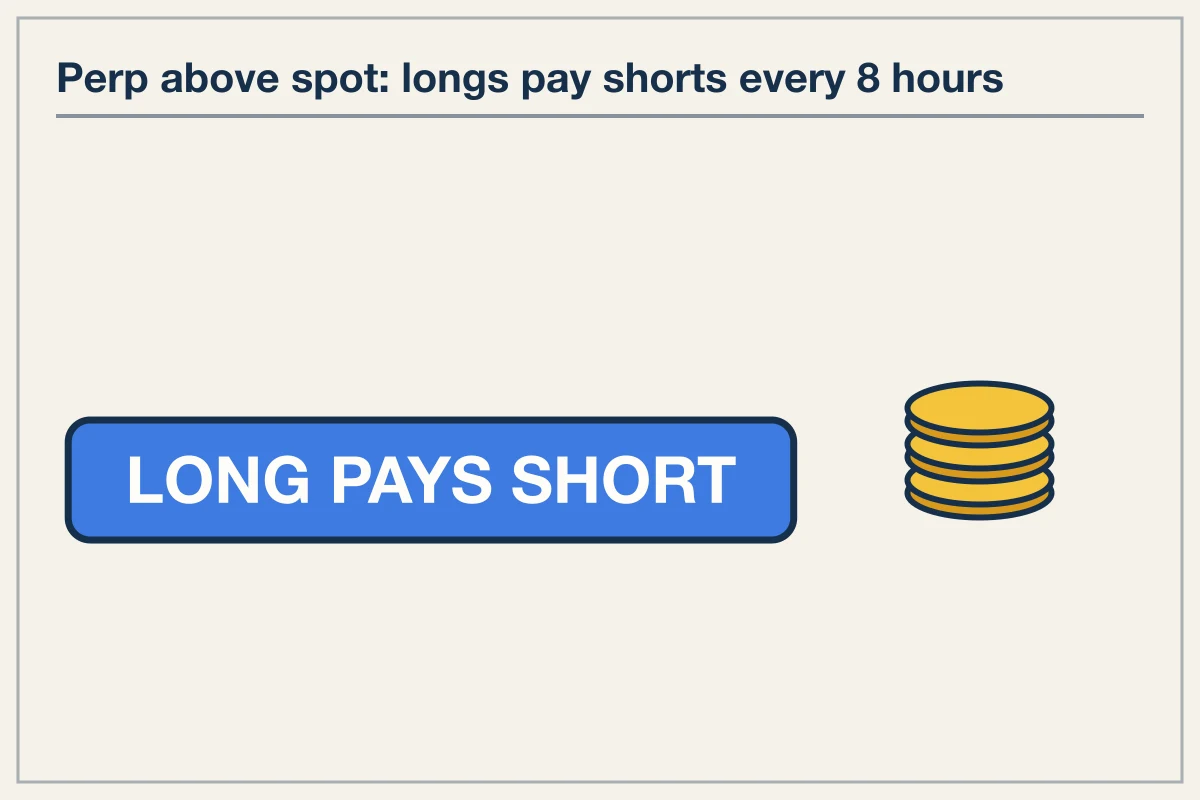
When perpetual futures trade above index spot prices, long holders pay funding to short holders every eight hours. When perpetual futures trade below spot, short holders pay long holders. Generating a net yield from this imbalance requires maintaining balances across two independent exchange accounts.
Worth knowing
Funding rate spreads fluctuate dynamically every eight hours. A venue yielding the highest funding rate during one cycle can compress to zero or invert during the next settlement period.
Live market spreads and venue execution costs
Current exchange data shows how funding rates differ across major crypto assets and perpetual venues. Spreads range from 0.0000% per 8-hour interval on stable assets like XAU up to 0.0296% on higher-volatility contracts like SNDK.
| Asset | 8h Spread | Daily Spread | 24h Volume | Lowest Funding Venue | Highest Funding Venue |
|---|---|---|---|---|---|
| ETH | 0.0066% | 0.0198% | $12,944,488,666 | MEXC (-0.0001%) | Bybit (+0.0065%) |
| BTC | 0.0036% | 0.0108% | $8,645,622,358 | OKX (+0.0026%) | MEXC (+0.0062%) |
| ZEC | 0.0203% | 0.0609% | $1,733,011,044 | MEXC (-0.0103%) | Bybit (+0.0100%) |
| SOL | 0.0049% | 0.0147% | $1,472,444,622 | Bitget (+0.0012%) | OKX (+0.0061%) |
| SNDK | 0.0296% | 0.0888% | $1,025,508,981 | Bybit (+0.0000%) | Bitget (+0.0296%) |
| XAU | 0.0000% | 0.0000% | $686,356,557 | Bybit (+0.0000%) | OKX (+0.0000%) |
Capturing these funding spreads requires paying trading fees on both venues at entry and exit. Base fee schedules determine the cumulative cost threshold required before a cash-and-carry or cross-venue position breaks even.
| Venue | Spot Maker | Spot Taker | Futures Maker | Futures Taker |
|---|---|---|---|---|
| Bitget | 0.10% | 0.10% | 0.02% | 0.03% |
| Bybit | 0.10% | 0.10% | 0.02% | 0.055% |
| MEXC | 0.00% | 0.05% | 0.00% | 0.02% |
| OKX | 0.08% | 0.10% | 0.02% | 0.05% |
Calculating real returns from funding rate arbitrage
Consider a cash-and-carry trade on ETH using spot long on MEXC and short perpetual on Bybit. The live 8-hour funding rate on Bybit is +0.0065%, while MEXC spot carries no funding rate fee. This creates a baseline funding yield of 0.0065% per 8 hours, or 0.0195% per day.
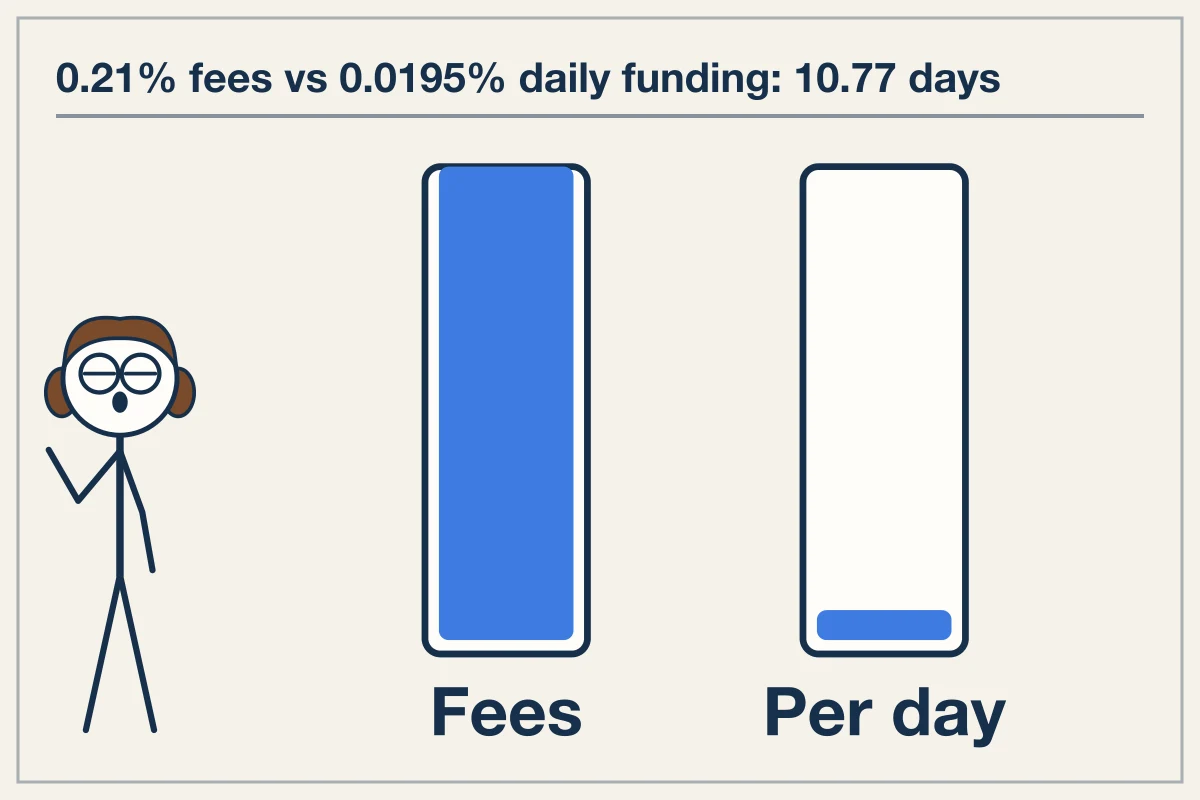
Entering the trade with market taker orders incurs a 0.05% taker fee on MEXC spot and a 0.055% taker fee on Bybit futures, totaling 0.105% on entry. Closing both legs with market orders adds another 0.105%, resulting in a round-trip fee drag of 0.21%.
At a daily funding rate of 0.0195%, the position requires 10.77 days (32.3 funding settlements) to cover execution fees. If the funding spread decays back to zero after three days, the position closes at a net loss despite receiving every scheduled funding settlement.
Where this goes wrong
Rapid upward price expansion drains margin on the short perpetual leg. A sharp market rally forces collateral rebalancing from the spot exchange to the futures venue to prevent liquidation.
Capital efficiency and liquidation risks
Executing cash-and-carry or cross-venue perpetual trades splits trading capital into isolated pools across separate venues. The long leg holds spot asset value or long contract collateral, while the short leg holds margin to buffer against price expansion.
Because short perpetual positions use leverage to conserve capital, traders often maintain 3x to 5x leverage on the futures venue. If the underlying market rallies sharply, the short perpetual incurs unrealised mark-to-market losses while the long leg accumulates matching gains. However, capital cannot automatically transfer between separate venues to maintain margin thresholds.
What to do instead
Calculate full round-trip taker fees and maintain unallocated collateral reserves on short perpetual venues before establishing cross-venue funding positions.
How long does it take for funding rate arbitrage to break even on trading fees?
Breakeven timing depends on fee tiers and the active rate spread. On major pairs like ETH with a 0.0195% daily spread, round-trip taker fees of 0.21% take over 10 days of continuous funding collection to recover.
What happens if a funding rate spread reverses while a position is open?
If the funding spread inverts, the short position pays funding instead of receiving it. Traders must either close the position and absorb remaining exit fees or hold a negative-yield trade until rates normalise.
Why does leverage increase liquidation risk on market-neutral funding trades?
Although spot gains balance short perp losses on paper, collateral remains locked in separate exchanges. A fast market rally depletes margin on the short exchange, triggering liquidation before funds can be transferred from the spot account.
Which venue currently offers the highest funding spread for altcoins?
Among active listings, SNDK exhibits a 0.0296% spread per 8-hour interval between Bybit at 0.0000% and Bitget at +0.0296%.